Stages of Drawing Development by Age: A Parent's Guide (1–8)
You’re handed a piece of paper with what looks, at first glance, like a tornado of purple scribbles. “It’s Grandma at the beach,” your three-year-old announces, completely serious. You squint. You nod. You stick it on the fridge. And somewhere in the back of your mind, a quiet worry flickers: should her drawings look more like drawings by now?
Here’s the thing: that tornado on paper isn’t random. It’s a snapshot of exactly where your child is on a predictable, well-documented developmental path. Researchers have been studying the stages of drawing development for over a century, and what they’ve found is reassuring. Every wobbly line, every floating head with stick legs, every overlapping rainbow is your child working through a specific cognitive task, and they’re doing it on schedule.
This guide walks through the four stages most children move through between ages one and eight, the drawing milestones to expect at each age, what it all means for their brain and body, and how to spot the difference between “perfectly normal” and “worth a conversation with the GP.”
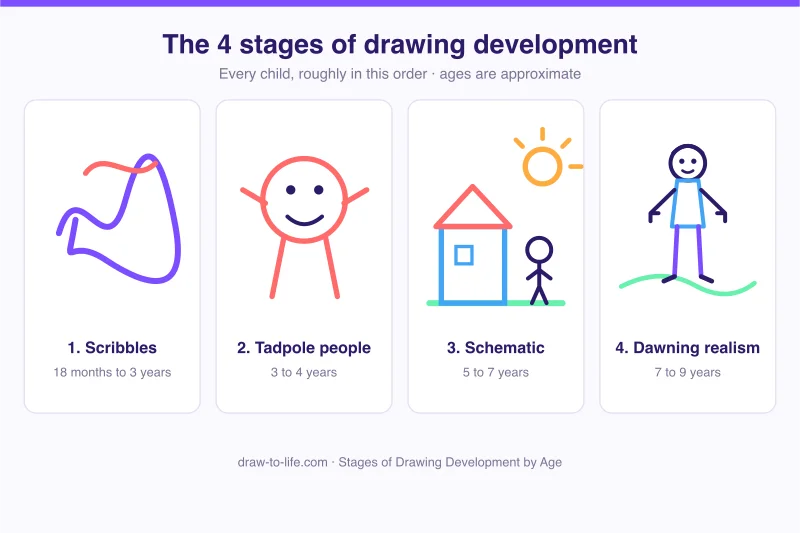
The four stages at a glance
| Stage | Ages (approx.) | What you’ll see |
|---|---|---|
| 1. Scribble stage | 18 months – 3 years | Random marks become controlled loops and lines; the act matters, not the result |
| 2. Pre-schematic (tadpole) stage | 3 – 4 years | First symbols: tadpole people, floating shapes, colours that ignore reality |
| 3. Schematic stage | 5 – 7 years | Fixed formulas for familiar things, the baseline appears, scenes tell stories |
| 4. Dawning realism | 7 – 9 years | Comparison with the real world begins, detail rises, confidence often wobbles |
Ages are approximate and children regularly straddle two stages at once. If you’ve come across five or six-stage versions of this model, they’re the same framework: Viktor Lowenfeld’s original sequence continues into the teenage years with the pseudo-naturalistic stage (11 to 13) and the period of decision (13 and up). For children aged one to eight, the four above are the ones that matter.
Where the stages come from
Most of what we know about drawing development comes from the work of Viktor Lowenfeld, an art educator writing in the 1940s, and later Rhoda Kellogg, who analysed nearly a million children’s drawings from around the world. Their finding, confirmed by decades of follow-up research, was that children everywhere move through the same sequence of drawing stages, in roughly the same order, at roughly the same ages. The timing varies, but the pattern doesn’t.
What’s changed since their work is our understanding of why. Modern developmental psychology sees drawing as a window into three things happening at once: fine motor control, cognitive symbol-making, and emotional expression. A child who draws a blue sun isn’t getting it wrong. They’re doing something much more interesting: deciding that suns can be whatever colour they want them to be.
Stage 1: The scribble stage (roughly 18 months to 3 years)
The first drawings aren’t drawings at all. They’re movement. A toddler grips a crayon in their fist, bangs it on the paper, and watches something appear. That’s a revelation: the first time many children understand that their actions can leave a permanent mark on the world.
Early scribbles are random: dots, stabs, zig-zags that run off the edge of the paper. Around two and a half, scribbles become controlled. Your child starts to make circles, vertical lines, and loops on purpose. They might not be able to tell you what they drew, because at this stage the act is the point, not the result.
What’s happening underneath: The scribble stage is pure fine-motor development. Your child is learning grip strength, hand-eye coordination, and the cause-and-effect link between their hand and the page. This is the foundation for writing.
What helps: Big paper, chunky crayons, no expectations. Resist the urge to ask “what is it?” They’ll tell you when there’s something to tell.
Stage 2: Pre-schematic, the tadpole years (roughly 3 to 4)
Suddenly, the scribbles mean something. A circle becomes a face. Two dots become eyes. Lines sprout from the circle and become arms and legs. Welcome to the tadpole stage, and yes, that’s the technical term.
Tadpole people are one of the most studied phenomena in child development. Your child will draw humans as a head with legs coming straight out of it, often skipping the body entirely. This isn’t a mistake. Research suggests children at this age draw what they find most important about a person (the face, where the feelings live) and then add limbs, because people need to move.
Colours stop matching reality. Skies can be pink, trees can be purple, and Dad might be bright green. That’s a feature, not a bug. Your child is discovering that a drawing is a symbol, not a photograph.
What helps: Ask open questions. “Tell me about your drawing” beats “what is it?” every time. If they pause, don’t finish the sentence for them.

Stage 3: The schematic stage (roughly 5 to 7)
This is the stage where the fridge starts filling up fast. Your child develops a repertoire, a “schema”, for drawing familiar things. Their house has a triangle roof, four square windows, and a chimney with curly smoke. Their cat always has whiskers and a specific tail shape. Every tree is a brown trunk with a green cloud on top.
The schematic stage is also where the baseline appears. Your child draws a horizontal line across the bottom of the page and stands everything on it: people, flowers, the family dog. The sky becomes a blue strip along the top. This baseline isn’t laziness or a failure to observe. It’s a cognitive breakthrough: your child has discovered that drawings need organisation, that things belong in a spatial order.
Expect exuberance with colour, experiments with x-ray drawings (where you can see inside the house, or the baby inside the pregnant belly), and stories embedded in every image. If you’ve ever read our piece on how AI helps kids express their creativity, this is the age where that matters most. Children at the schematic stage are brimming with ideas their hands can’t quite execute yet.
Red flags at this age: A child who has never moved past tadpole figures by age six, who avoids drawing completely, or who shows a sudden, dramatic shift in what they draw (much darker themes, for instance) may benefit from a chat with their teacher or GP. Drawing is one of several developmental markers, not a standalone test, so look at the whole picture.
Stage 4: Dawning realism (roughly 7 to 9)
Somewhere around the seventh birthday, something shifts. Your child looks at the cat they’ve drawn the same way for two years and frowns. “That doesn’t look like a cat.” For the first time, they compare their work to the real world and, more painfully, to the polished drawings in picture books and on screens.
This is the moment developmental psychologists call the “crisis of realism.” It’s the reason so many children stop drawing altogether around age eight. The gap between what they can imagine and what their hands can produce becomes unbearable. We’ve written at length about how to encourage reluctant drawers, because this stage is where the most damage is done, and the most support is needed.
Drawings become less exuberant, more self-conscious, more focused on getting it “right.” You may see erasing, sighing, and the phrase every parent dreads: “I can’t draw.” What’s really happening is a cognitive leap. Your child has developed the critical eye of an artist before they’ve developed the hands of one.
What helps: Celebrate process over product. Draw alongside them and make mistakes cheerfully. Introduce tools that bridge the imagination gap (sketching, tracing, collage, and yes, AI-assisted creative apps) so that a child whose hands haven’t caught up yet can still see their ideas realised. Tools like DrawToLife exist precisely for this stage, turning a child’s drawing into polished artwork that matches the vision in their head, without ever replacing the drawing itself.
Drawing milestones by age
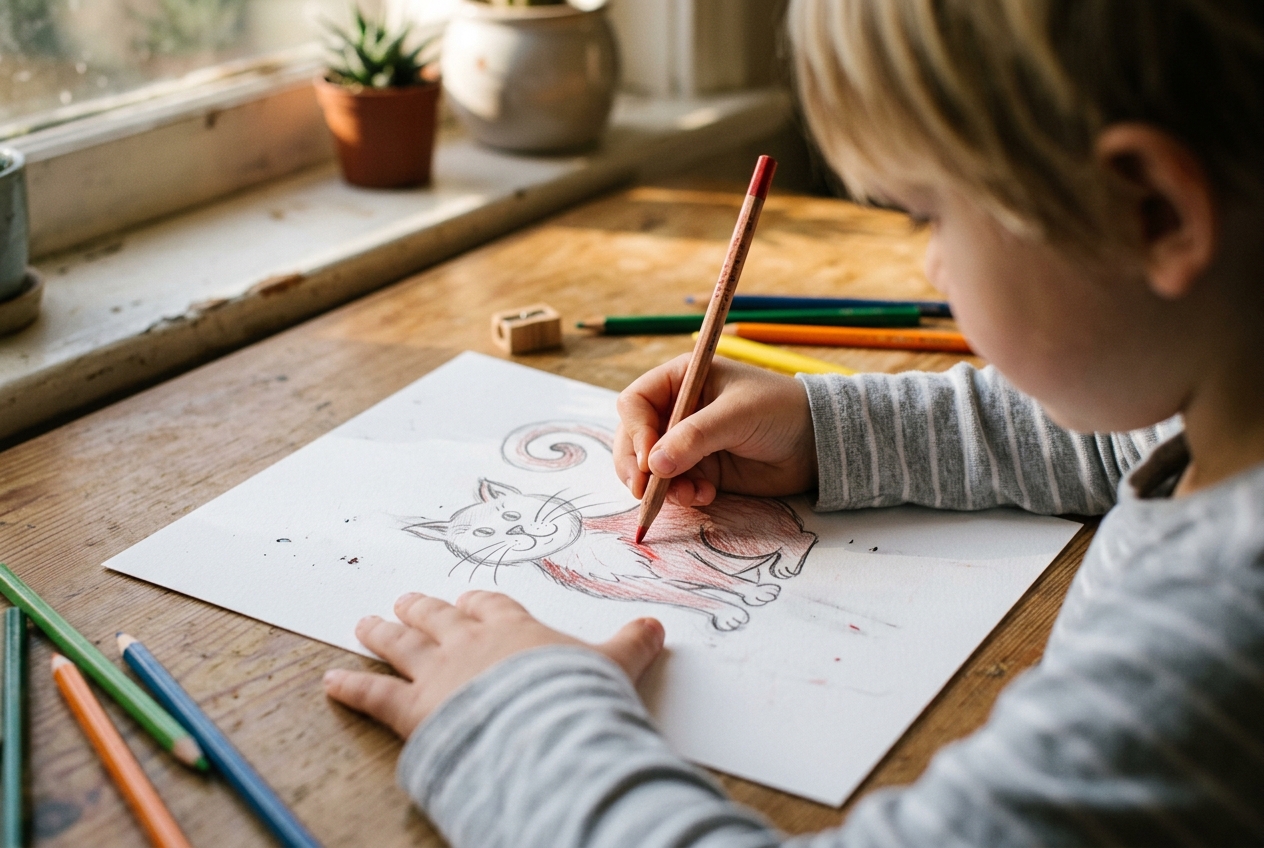
The stages describe the journey; parents usually want to know about their child’s age today. Here’s the same path year by year. Treat every age as a middle, not a deadline: the normal range around each milestone is roughly a year in both directions.
- 12 to 18 months: First marks. A crayon held in the fist, whole-arm movement, and delight that the mark stays put.
- 2 years: Controlled scribbling. Imitates a vertical line and circular scribbles; starts filling the page on purpose.
- 3 years: Copies a circle. The first tadpole person usually appears; finger grip starts replacing the fist.
- 4 years: Copies a cross. Draws a recognisable person with two to four parts and names the things they draw.
- 5 years: Copies a square. People gain bodies, arms and legs; the house-sun-family schema arrives; first letters sneak in.
- 6 years: Copies a triangle. Baseline scenes with sky on top; details multiply: fingers, clothes, whiskers, chimney smoke.
- 7 years: First attempts at proportion and action; figures start doing things rather than posing in a row.
- 8 years: The realism drive. Overlap, depth and perspective attempts, and a newly critical eye on their own work.
How children learn to draw a person
Person drawings are so predictable that researchers use them as a rough developmental yardstick (the classic “draw-a-person” measures). The sequence runs: scribbles that your child names as a person (around 2 to 3), the tadpole figure (around 3), a tadpole with a separate body (4 to 5), a six-part person with head, trunk, arms and legs (around 5), detailed figures with hands, hair and clothes (6 to 7), and finally proportion, movement and profile views (8 and up).
Two reassurances. First, detail in a person drawing tracks what a child notices, not how much they love you: the giant head with no ears is not a comment on your listening. Second, these measures are screening tools in professional hands, not something to score at the kitchen table. If the drawings keep changing over the months, development is doing its job.
When to worry (and when not to)
Most variation is perfectly normal. Children who speak early often draw later, and vice versa. Boys and girls tend to move through the stages at similar ages, though the subjects they choose can differ. A child who skips a stage, loops back to an earlier one, or stalls for six months is almost always fine.
A few patterns are worth a conversation with your health visitor, GP, or your child’s teacher. A child over four who has never drawn a recognisable figure and shows no interest in representing things. A child whose drawings regress significantly, becoming much simpler or more chaotic, after a period of steady progress. A child who consistently cannot hold a crayon or pencil by age four. A sudden, sustained shift to dark, frightening, or violent themes, especially alongside other behavioural changes. None of these are diagnostic on their own, but they’re worth mentioning alongside anything else you’ve been watching. Drawings carry feelings as well as milestones; our guide to how drawing helps kids process emotions covers that side of the page.
How to support every stage
The research is consistent on what helps: frequent, low-pressure access to drawing materials; adults who ask questions rather than give instructions; and a home where children see their drawings valued rather than corrected. A child who draws every day will move through the stages faster and go further than a child who draws once a week, regardless of talent.
Keep the supplies accessible. Rotate the crayons when they get stubby. Notice the drawing, not just the drawer. “I love how you made the sky swirl” beats “good job” every time.
Most of all, remember this: you’re not raising a future artist. You’re raising a thinker. Every stage of drawing development is your child practising the very thing you want them doing for the rest of their life: imagining something, putting it into the world, and seeing what happens next. The purple-tornado Grandma on the beach isn’t a rough draft of a real drawing. It’s already the real thing.