How to Talk to Kids About Their Art Without Saying 'Wow'
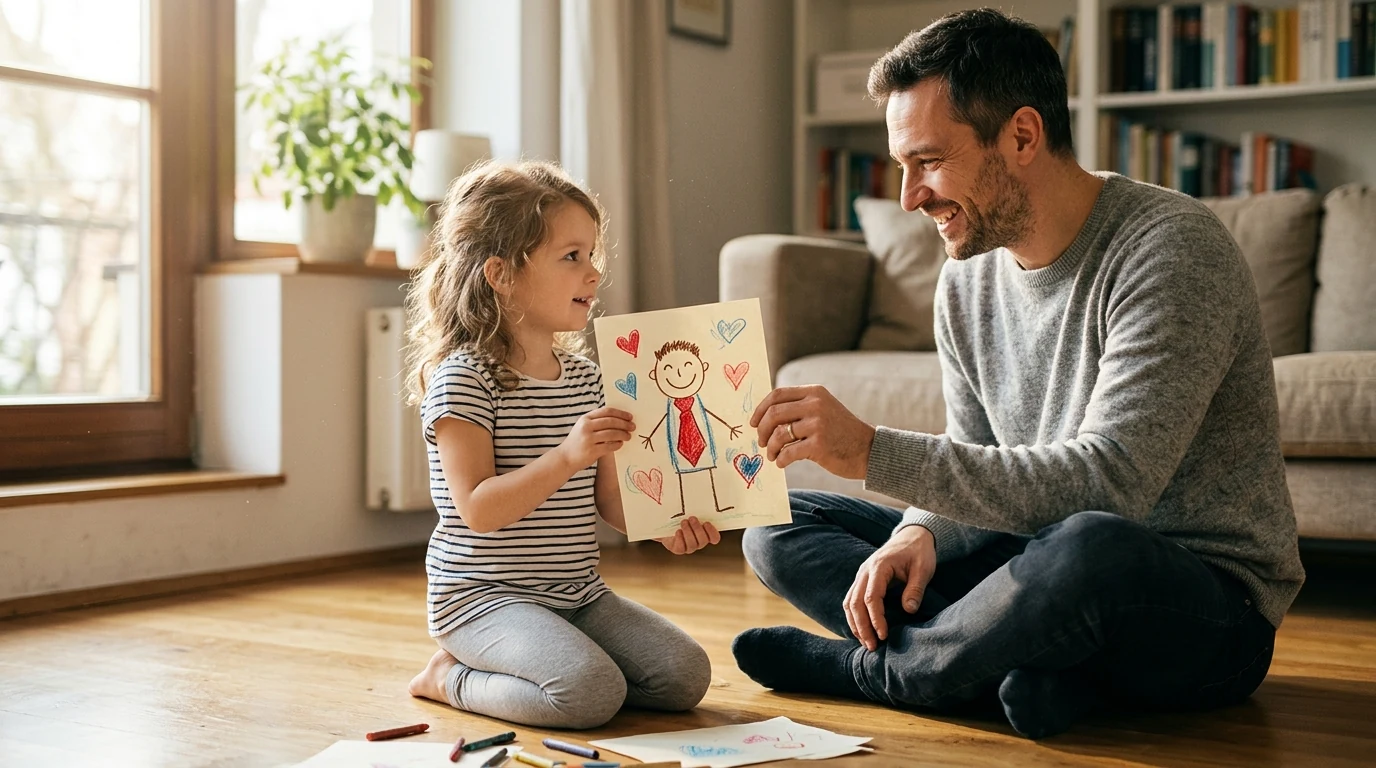
She runs in waving a piece of paper, grinning so hard you can see the gap where her front tooth used to be. “Look what I drew!” You glance up from the email you were halfway through, take in something that might be a horse or a dog or possibly a piece of toast, and say what every parent says: “Wow, it’s amazing, sweetheart.” She nods, satisfied, and wanders off. Five minutes later she is back with another drawing. You say “Wow” again. By the eighth drawing, you are saying it on autopilot, and somewhere around the tenth, she stops bringing them to you at all.
If you have ever wondered how to talk to kids about their art in a way that actually means something — that builds confidence rather than chipping at it — you are not alone. The default scripts most of us grew up with (“That’s lovely, well done!”) are warm, well-meant, and surprisingly hollow. Children, even very small ones, can tell the difference between a real response and a polite one. And the words we choose in those small kitchen-table moments quietly shape whether a child grows up feeling like an artist or like someone whose drawings exist only to be praised by grown-ups.
The good news: the alternative is not complicated. It is mostly slower, more curious, and a bit more honest. Here is what developmental psychologists and art educators have been quietly telling us for years.
Why “wow” might not be the win we think it is
Decades of research on praise, starting with Carol Dweck’s work on mindset and continuing through more recent studies on intrinsic motivation, has landed on a fairly clear conclusion. Generic praise — “amazing”, “beautiful”, “you’re so talented” — feels good for a moment, but it teaches children that the point of making something is to earn the next round of applause. Over time, kids start drawing what they think will get a reaction, abandon work that does not look “good enough”, and develop a fragile relationship with their own creativity.
This is not a reason to stop being warm. It is a reason to be more specific. The opposite of empty praise is not coldness — it is attention. When you describe what you actually see (“You used so much purple in this one”), ask a real question (“How did you decide where the dragon should be?”), or notice the effort (“Those tiny scales must have taken ages”), you tell the child something more powerful than “wow.” You tell them: I am genuinely looking at what you made.
Notice before you praise
The single most useful habit you can build is to describe before you evaluate. When your child shows you a drawing, resist the reflex to grade it. Instead, narrate.
“You filled the whole page this time.”
“There are three suns up there.”
“This bit looks really busy and this bit is empty.”
That’s it. No thumbs up, no scoring, no “well done”. Notice colour, shape, composition, repetition, the things that are not there. Children learn an extraordinary amount from this kind of mirroring, because they hear that someone is looking carefully at their work — and they start looking carefully at it too. The artist Robert Henri called it “respect for what is on the page”, and that is exactly the gift you are giving.
It also gives you something to talk about. “I notice you drew yourself much smaller than your sister” might open a five-minute conversation about what is going on at school. Children’s drawings are full of information they are not yet able to put into sentences, and slowing down to describe them is often the only invitation they need.
Ask the right kind of questions
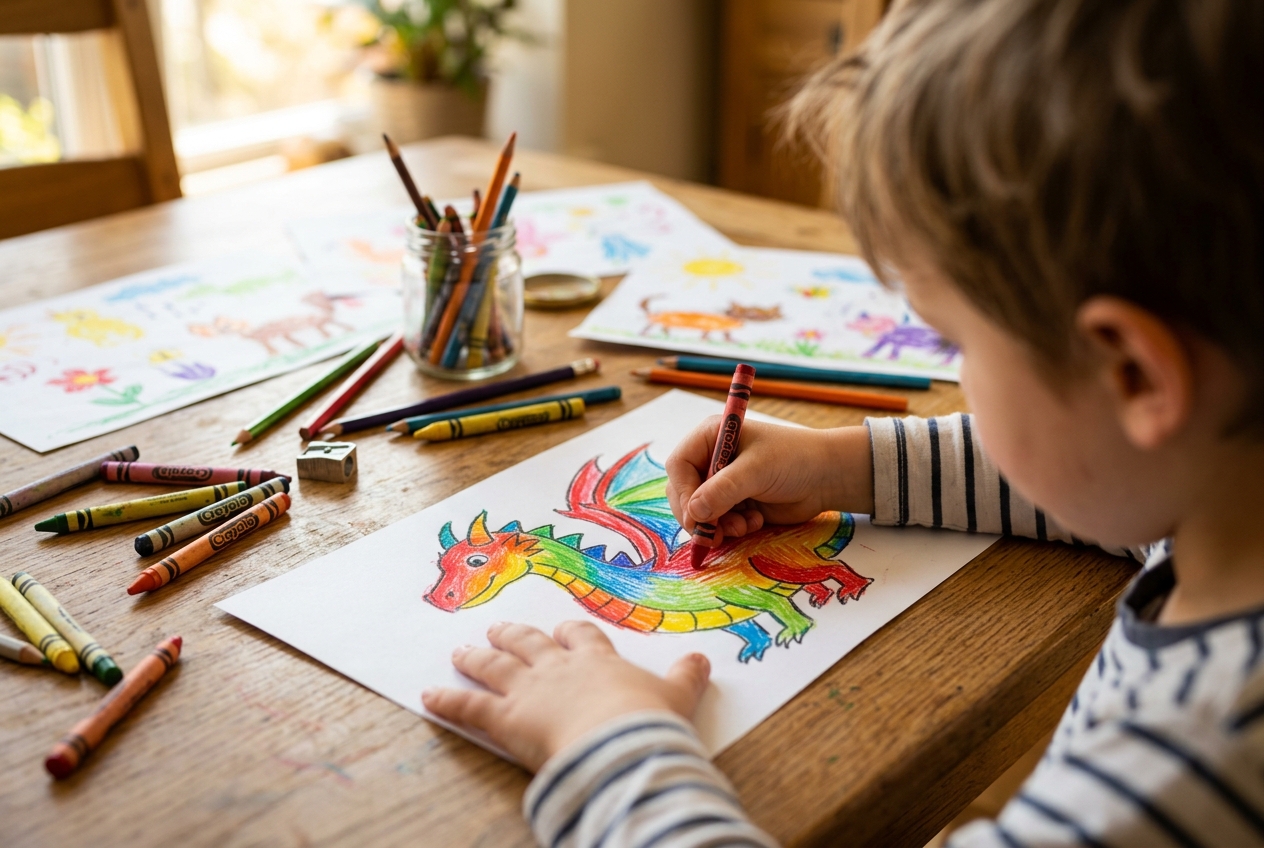
Questions are where most of us go wrong. The classic blunder — and we have all done it — is “What is it?” To a three-year-old who has just drawn an elaborate scene of a family picnic with talking biscuits, “What is it?” lands like an accusation. They thought it was obvious. Now you have made them defend it.
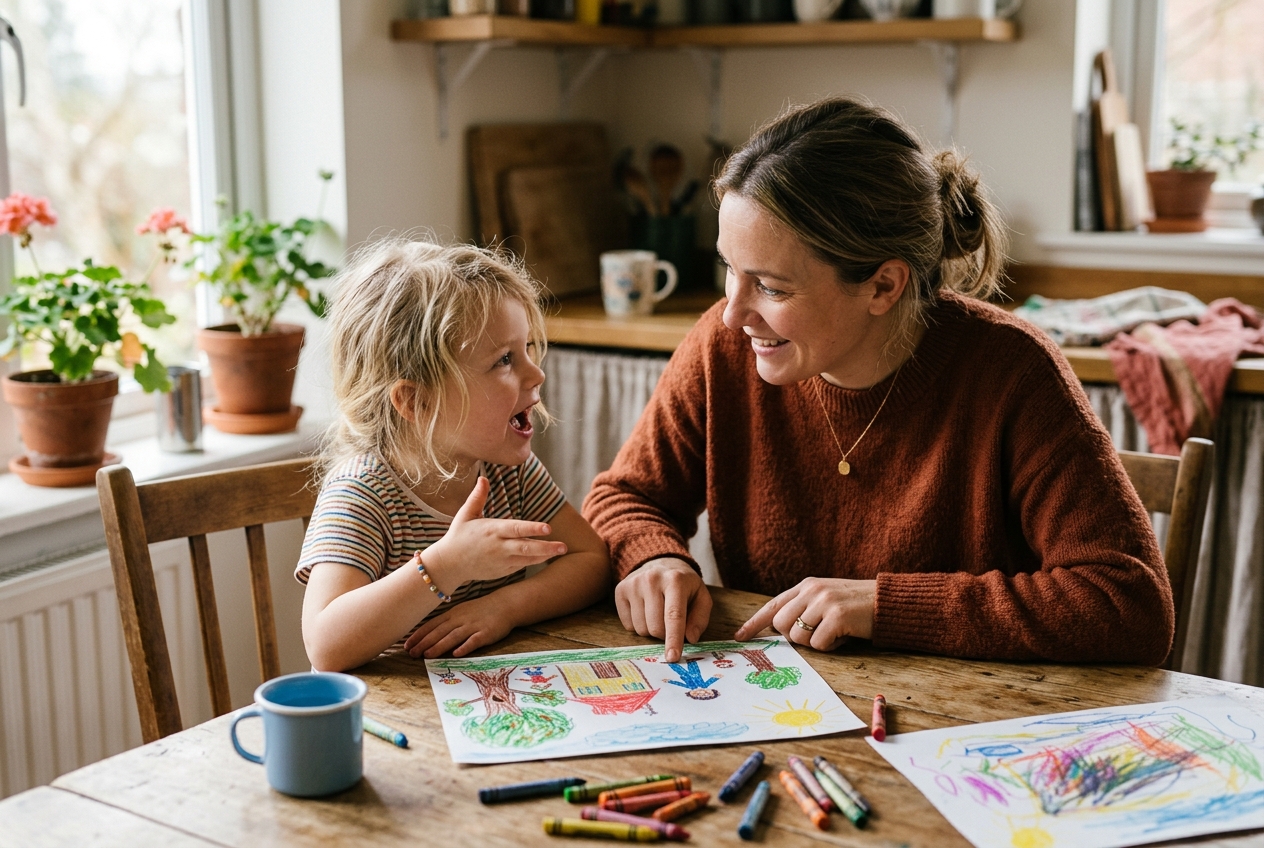
A more useful question pattern is open and process-focused, not identification-focused. Try:
- “Tell me about it.”
- “What was happening when you drew this?”
- “Which part was the most fun to do?”
- “Was there a tricky bit?”
- “What were you thinking about when you started?”
Notice that none of these ask the child to name the subject. They ask about the making. This matters because the making is where the learning lives. A child who can talk about why they chose a particular colour, or which bit was hard, is building the metacognitive muscles that will serve them in writing, maths, and every creative pursuit they ever take on.
If you genuinely cannot work out what a drawing is and the child is waiting for a reaction, “Tell me about it” is your safest opener every time. They will happily fill you in. You will be amazed how often the squiggle you assumed was a cloud turns out to be Granny on a roller coaster.
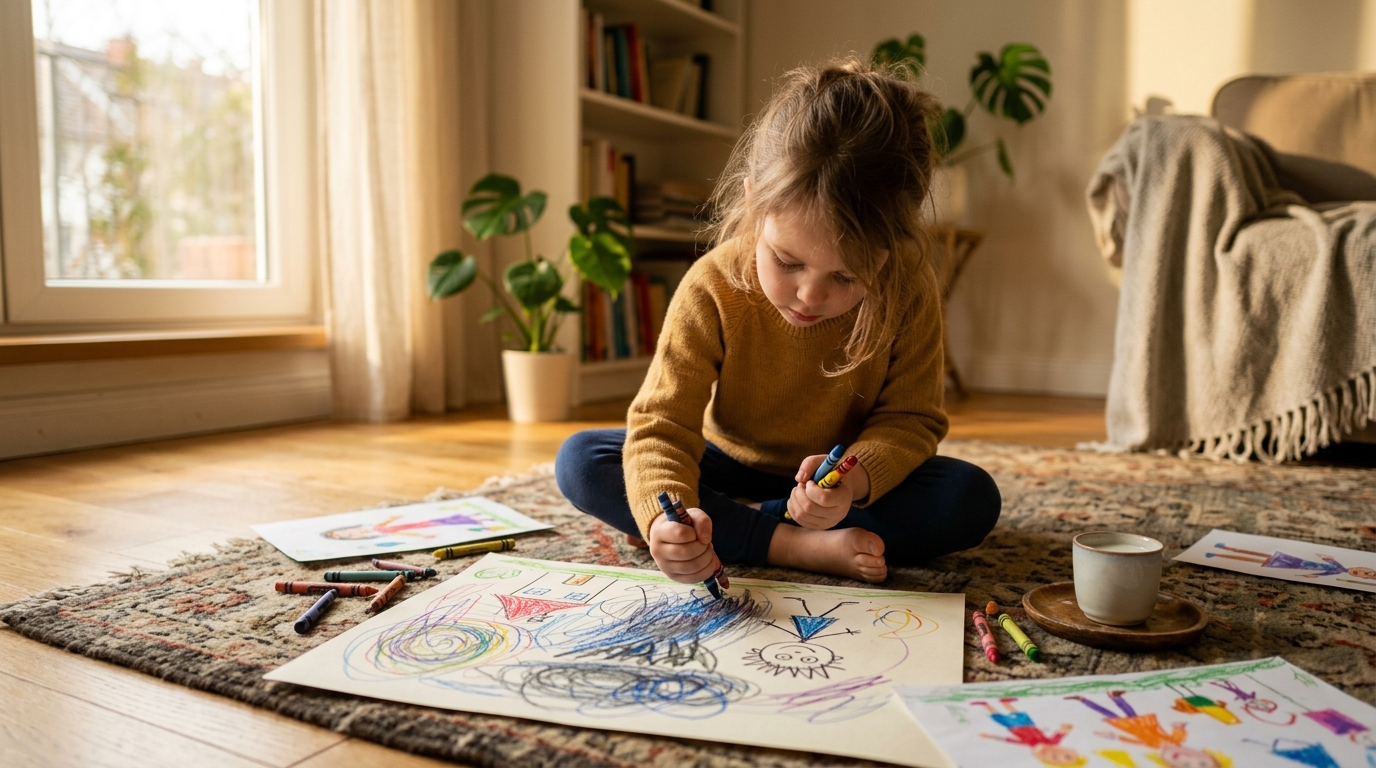
When your child says “I can’t draw”
Sooner or later, every child looks at their own work and decides it is not good enough. For some children this hits at five, for others at seven or eight, but it is so consistent that developmental psychologists have a name for it — the “crisis of realism”. We have written more about it in our guide to encouraging kids to draw, even reluctant ones, but the language piece is worth its own treatment.
The wrong response is to argue. “Of course you can! It’s beautiful!” tells the child that you are not really seeing what they are seeing, which makes them trust your praise less, not more. The right response is to validate the gap and reframe the goal.
Try: “You’re noticing that the dog in your head looks different from the dog on the paper. That is a really hard problem, and every artist works on it their whole life.”
Or: “You wanted it to look one way and it came out another way. That happens to grown-up artists all the time. Want to keep going, or try a different one?”
Or, my favourite for very small dramatic announcements: “You’re not stuck — you’re at the bit where it gets interesting. Most people stop here. Artists keep going.”
What you are doing in each of these is naming the experience honestly while removing the verdict. The drawing is not “bad” or “good”. It is a thing in progress, made by a person who is learning to see.
Talk about effort and choices, not talent
The word “talented” is one of the most well-meaning small bombs you can drop on a child. It sounds lovely. What it actually does, if used regularly, is teach the child that their ability to draw is a fixed thing they were born with — and that any future struggle means the talent has run out. Children who hear “you’re so talented” a lot tend to take fewer creative risks, because risking failure means risking the identity.
The fix is to swap “talented” for words that name what the child actually did: chose, tried, kept going, noticed, decided.
“You decided to make the sky green this time. What made you try that?”
“You kept going even when the wing was tricky.”
“That is a really original idea. I haven’t seen anyone draw a wedding for fish before.”
These are tiny, unglamorous swaps, but over a few months they reshape how a child thinks about their own creative work. The story they tell themselves shifts from “I am or am not someone who can draw” to “I make things, and I keep getting better at making things.” That second story is the one that survives the crisis of realism — and survives adolescence, and survives life.
What to do with the finished drawing
A surprising amount of how kids feel about their art is not about the words at all. It is about what happens to the drawing afterwards. A drawing that gets stuck on the fridge for a fortnight, then quietly tucked into the recycling, sends a different message from one that gets photographed, framed, or transformed into something new.
This is where small rituals help. Some families keep a “best of the week” folder. Some scan one drawing a month and stick the print in a binder. Some — and this is genuinely magical for a five-year-old — use tools like DrawToLife to take a child’s crayon scribble and turn it into a polished watercolour, anime scene, or 3D character, then print the result alongside the original. Watching their wobbly dragon become a glossy piece of artwork tells them something simple and important: what you make is real, and worth keeping.
Whatever ritual you pick, the point is the same. You are showing the child, in actions rather than words, that the work matters. (For more on this, our post on creative ways to display kids’ art at home has a stack of practical ideas.)
A small script you can actually use
If all of this feels like a lot to remember in the heat of a Tuesday afternoon, hold on to one tiny sequence. The next time your child shows you a drawing, try, in this order:
- Stop what you’re doing. Put the phone down. Make eye contact.
- Describe one thing you actually see. “You used so much yellow in the sky.”
- Ask one open question. “Tell me about this part here.”
- Listen to the answer. Properly. They will tell you more than you expect.
- Name the effort or the choice, not the talent. “I love that you decided the cat would have a hat.”
That is the whole game. Five steps, maybe ninety seconds, and the message your child receives is enormous: my grown-up sees me, takes my work seriously, and is curious about how my mind works. No “wow” required.
The strange and lovely thing is that, once you start doing this, your child’s drawings change. They get bolder, weirder, more theirs. Because when a child believes their grown-ups are genuinely paying attention, they stop drawing for the applause and start drawing for themselves. Which, in the end, is the only kind of artist any of us ever wanted to raise.