Drawing Games for Kids: 12 Screen-Free Family Favourites
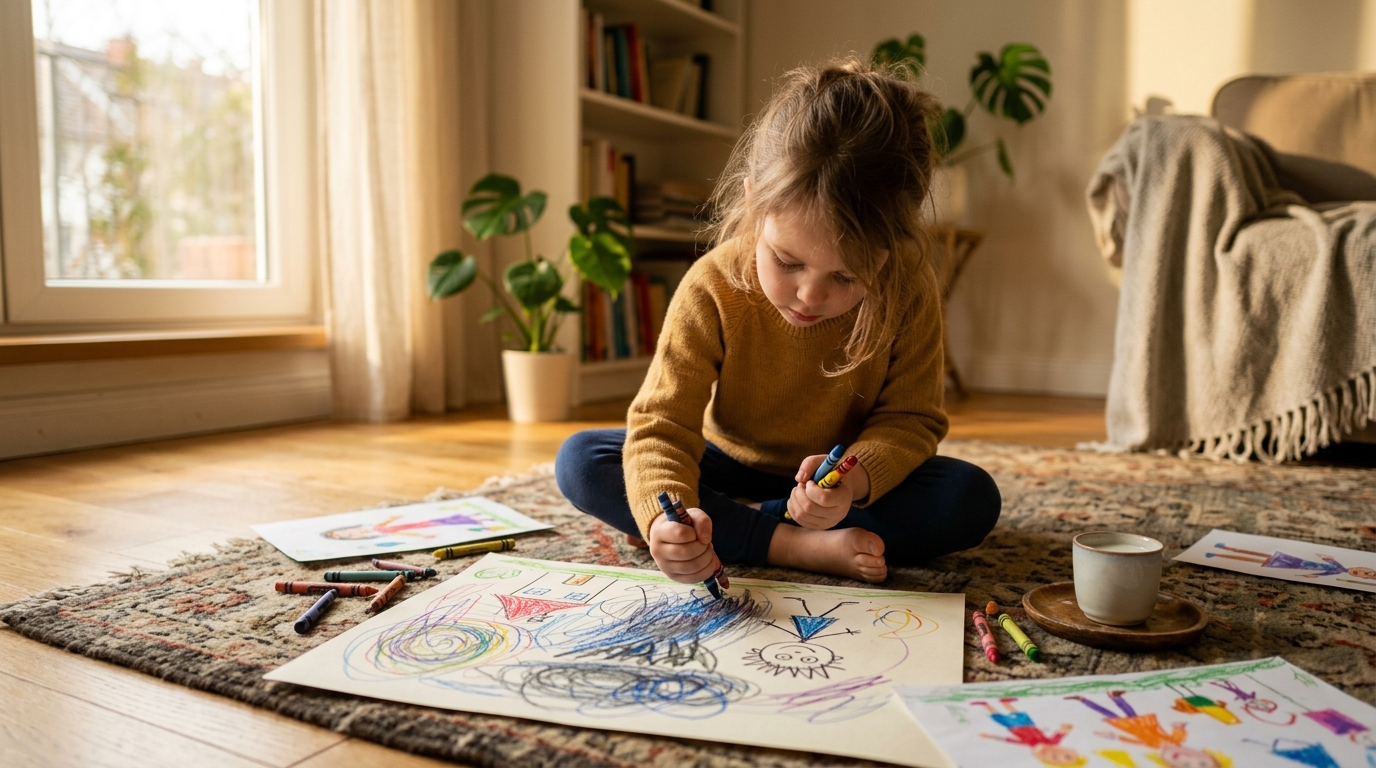
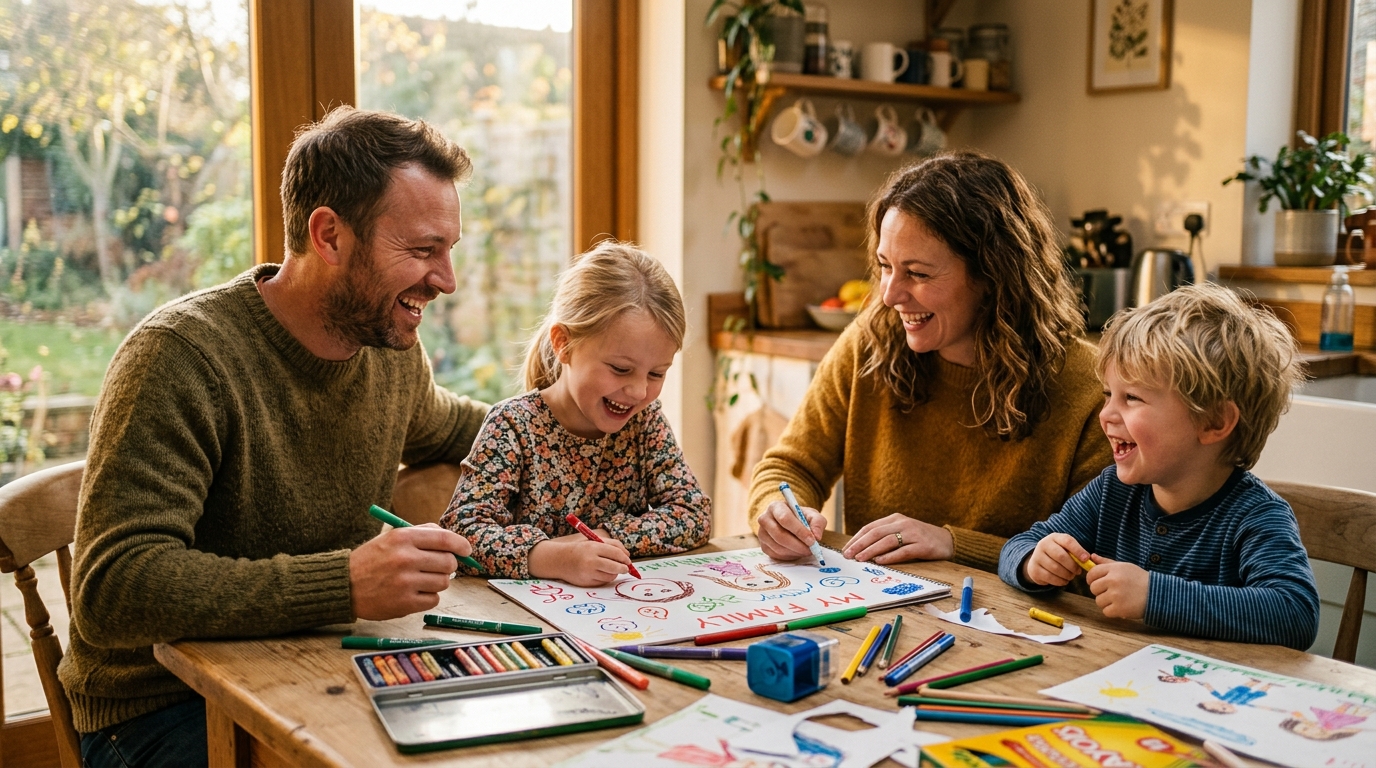
Sunday afternoon, the kitchen table is a disaster, and my nephew has just declared that his drawing of a pirate is “rubbish” and slid it across the table like a man handing in his resignation. My sister, without missing a beat, picked up a pen, added three tentacles and an eyepatch, and pushed it back. He howled with laughter. Within two minutes, the whole family was taking turns adding something ridiculous — a fish sheriff, a flying cheese, a submarine cat — and the pirate had become the star of a chaotic underwater courtroom.
That is the magic of drawing games for kids. A child who flinches at a blank page will happily draw for an hour when there is a game on, a grown-up next to them, and a goal that is not “make something good” but “make us all laugh.” Games sidestep perfectionism, create shared attention, and — this is the hidden bonus — turn drawing from a solo performance into a family conversation.
If you have ever wondered what to do with a fidgety Saturday, a long car journey, or the dreaded pre-dinner hour, these twelve games are built for exactly those moments. All you need is paper, a few pens, and a willingness to be the grown-up who draws a sheriff fish.
Why drawing together matters more than drawing well
Developmental psychologists have a phrase for what happens when an adult and a child focus on the same thing together: joint attention. It is the foundation of language, empathy, and learning itself, and it is surprisingly rare once children are old enough to play independently. Drawing games rebuild it. When two people share a page, they are also sharing a world — noticing the same squiggles, laughing at the same silly additions, negotiating what happens next.
Drawing games also take the pressure off. Research on creative development suggests that children between five and eight years old often hit a “crisis of realism” where they compare their own drawings unfavourably to what they see on screens, in books, or in a sibling’s sketchbook. We have written more about this in our guide to why children’s drawing skills matter. Games are the antidote: when the goal is to be silly together, there is no such thing as a bad drawing. There is only the next turn.
Five-minute games for ages 3-5
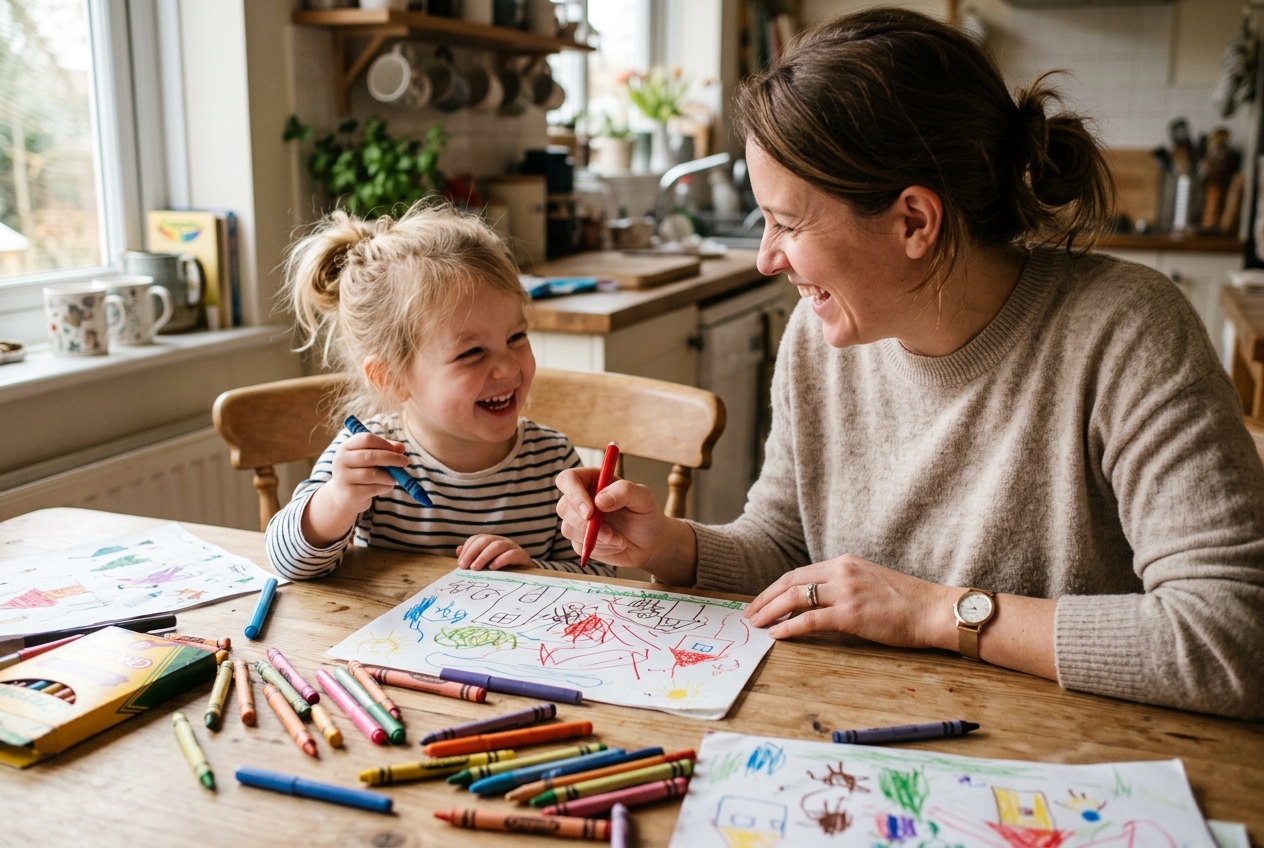
Younger children need games with clear rules, quick turns, and a built-in giggle. These three are reliable crowd-pleasers.
1. Scribble Monster. One person closes their eyes and scribbles for three seconds. The other person turns the scribble into a creature by adding eyes, legs, and a silly name. Swap. The rule for grown-ups is simple: commit. A two-headed potato called “Gerald” is exactly the right answer.
2. Finish the Shape. Draw a single shape — a circle, a squiggle, a zigzag — and ask your child what it is. Their job is to turn it into something. A circle might become the moon, a pancake, a grumpy face. The surprise is half the fun. Do ten shapes in a row and you will have a tiny gallery of accidental art.
3. Colour Pass. Each person picks one crayon and can only use that colour. Pass the paper every thirty seconds. The drawing morphs constantly — a red house suddenly has a green roof, then a purple sun, then a blue chimney. Younger children love the “stop and swap” rhythm, and it teaches a gentle lesson about building on other people’s ideas.
Turn-taking games for ages 5-7
By around five, children can hold a character in their head, follow a two-step rule, and enjoy a bit of mystery.
4. Head, Body, Legs. The old surrealist parlour game (sometimes called Exquisite Corpse) works brilliantly with kids. Fold a sheet of paper into three horizontal strips. Person one draws a head and neck at the top, folds it over so only two tiny guide lines peek out, and passes it on. Person two draws a body. Person three draws legs. Unfold at the end and collapse in giggles. Keep the finished creatures in a shoebox — our house has a growing collection of “the Wiggins family.”
5. Story Stack. Each player draws one picture that tells part of a story — no words allowed. The next player adds a drawing that continues it. Five or six rounds in, you have a comic. The rule is “add, don’t contradict” — if the last drawing had a dog, the dog stays. This is quietly wonderful for collaborative thinking.
6. Dot-to-Dot Duel. Fill a page with twenty random dots. Players take turns connecting two dots with a line. Whoever closes a shape gets to claim it by drawing something inside (an eye, a flower, a tiny monster). Most shapes at the end wins. It is the gentlest competitive game on this list and brilliant on a car journey.
7. Copy Cat, Bad Cat. One person draws something simple — a house, a cat, a tree. The other person has to “copy” it, but must change one thing every time they copy. By round five the original cat has wings, a top hat, and three tails. This is a sneaky way to teach visual observation without it feeling like a lesson.
Bigger games for ages 6-8
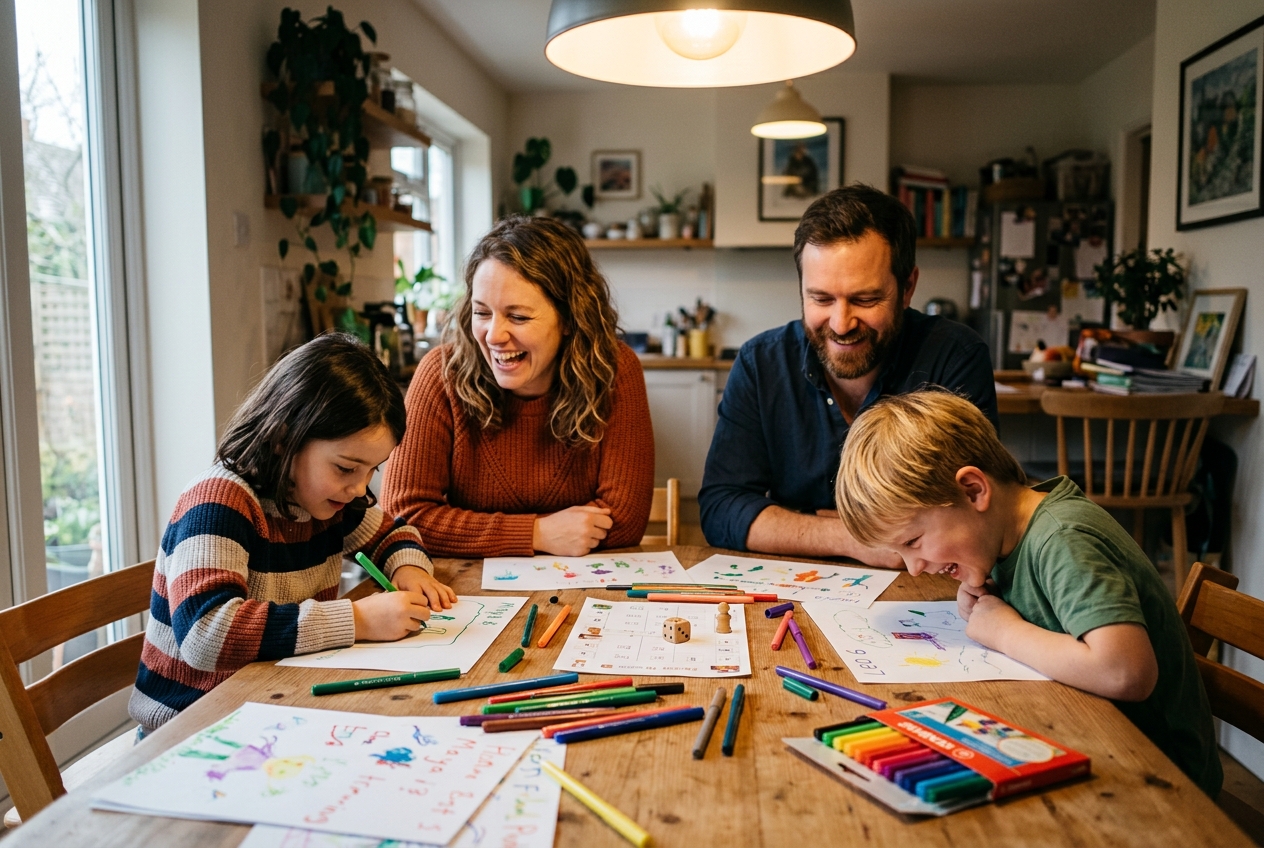
Older children can handle longer games, more rules, and a little strategy. These travel well to family dinners, sleepovers, and grandparents’ houses.
8. Roll-a-Monster. Write six options each for heads, bodies, and legs on three lists. Roll a die three times and draw the monster you land on (crocodile head + ballerina body + chicken legs). Even reluctant drawers will have a go, because the die did the hard bit — they just have to render it.
9. Pictionary for Tiny People. Same rules as the classic party game, simpler word list. Write words on folded paper — pizza, firefighter, dragon, bathtub, wizard. Set a one-minute timer. Teams guess. Grown-ups should cheerfully lose at least half the time. There is a whole deeper list of silly drawing activities that pair beautifully with this one.
10. The Mural. Tape a long roll of lining paper down the hallway and set a theme — underwater kingdom, jungle expedition, space rescue. Everyone adds to it across a weekend. Hang the finished thing on the fridge door or roll it up as a souvenir. The key rule: no erasing anyone else’s work.
11. Silhouette Surprise. Cut out a silhouette from an old magazine — a cat, a teapot, a person running. Stick it in the middle of a page. Each player draws a scene around it. The same silhouette becomes a dragon’s tail, a rocket, a shadow at a birthday party. Brilliant for showing children that the same shape can mean a hundred different things.
12. The AI Remix Round. Once every few games, let your child pick their favourite drawing from the afternoon and transform it with a kids’ AI art tool. Watching their wobbly crayon dragon become a polished watercolour, a Pixar-style character, or a claymation figure often lights up the room. Tools like DrawToLife are built for ages 3-8 and turn a child’s drawing into finished artwork in seconds — useful proof that their scribbles are, in fact, real art.
Setting up a drawing games drawer
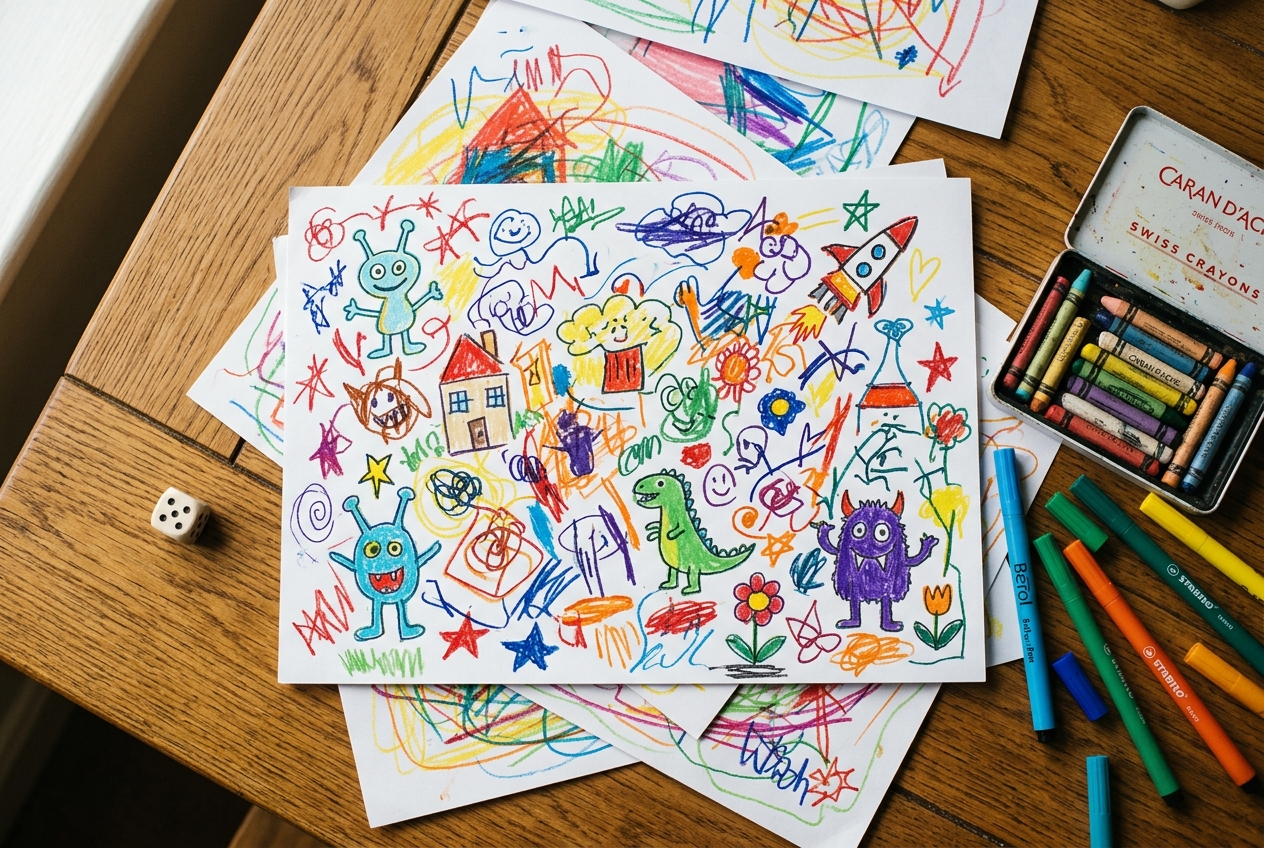
The families I know who play most often are not necessarily the most creative — they are the most prepared. A small drawer or tray with a stack of plain A4 paper, a tin of washable felt-tips, a pack of crayons, a roll of lining paper, and a six-sided die will do almost everything on this list. Keep it near the kitchen table, not in a craft room upstairs that requires an expedition to reach. Proximity is destiny.
A few ground rules help too. No erasers during games (you build on mistakes, you do not undo them). No judging anyone else’s drawing. The grown-ups draw too, badly and cheerfully. And when the game stops being fun, stop — nothing kills a drawing habit faster than one more round when someone’s had enough.
The quiet thing games teach
The biggest benefit of drawing games is not the drawing itself. It is the modelling. When children see the adults they love picking up a pen, making something silly, laughing at their own wonky lion, and not minding at all that it does not look like the one in the book, they learn that creativity is not a talent you either have or lack. It is a thing you do. A muscle. A habit. A slightly daft family ritual that involves a sheriff fish.
Next rainy Saturday, pull out the paper and pick one. Scribble Monster if you have ten minutes, Head-Body-Legs if you have twenty, The Mural if you have the whole weekend. The pirate does not have to be good. He just has to be part of the underwater courtroom.