Fun Drawing Activities for Kids That Spark Creativity
It’s half past four on a rainy Tuesday. The blocks have been built and knocked down twice, the play dough is drying out on the kitchen table, and your four-year-old is doing that restless orbit around the living room that means trouble is about ten minutes away. You grab a stack of paper and a handful of crayons, and say the magic words: “Want to draw something together?”
What happens next depends on what you suggest. A blank sheet of paper can feel like a gift or a burden to a young child, depending on whether they have a spark to get started. That’s where good drawing activities for kids come in — not worksheets or lessons, but playful prompts and games that turn drawing into an adventure.
Here are some of the best drawing activities for kids aged 3 to 8, organised by age so you can pick the ones that suit your child right now.
Drawing Activities for Ages 3-4: Scribbles With Purpose
At this age, children are still developing the grip strength and control to make deliberate marks. The goal isn’t recognisable pictures — it’s joyful mark-making and the realisation that they can create something on a blank page.
Scribble stories. Let your child scribble freely, then ask them to tell you what they see in the scribble. You’d be amazed how quickly a tangle of lines becomes “a dog running in the rain.” Write their caption underneath. This builds narrative thinking and validates their marks as meaningful — a key step in why children’s drawing skills matter for early development.
Colour hunts. Pick a colour — say, red — and walk around the house together finding red things. Then sit down and draw everything you found, using only that colour. It’s part scavenger hunt, part art project, and it sharpens observation skills without any pressure to “draw well.”
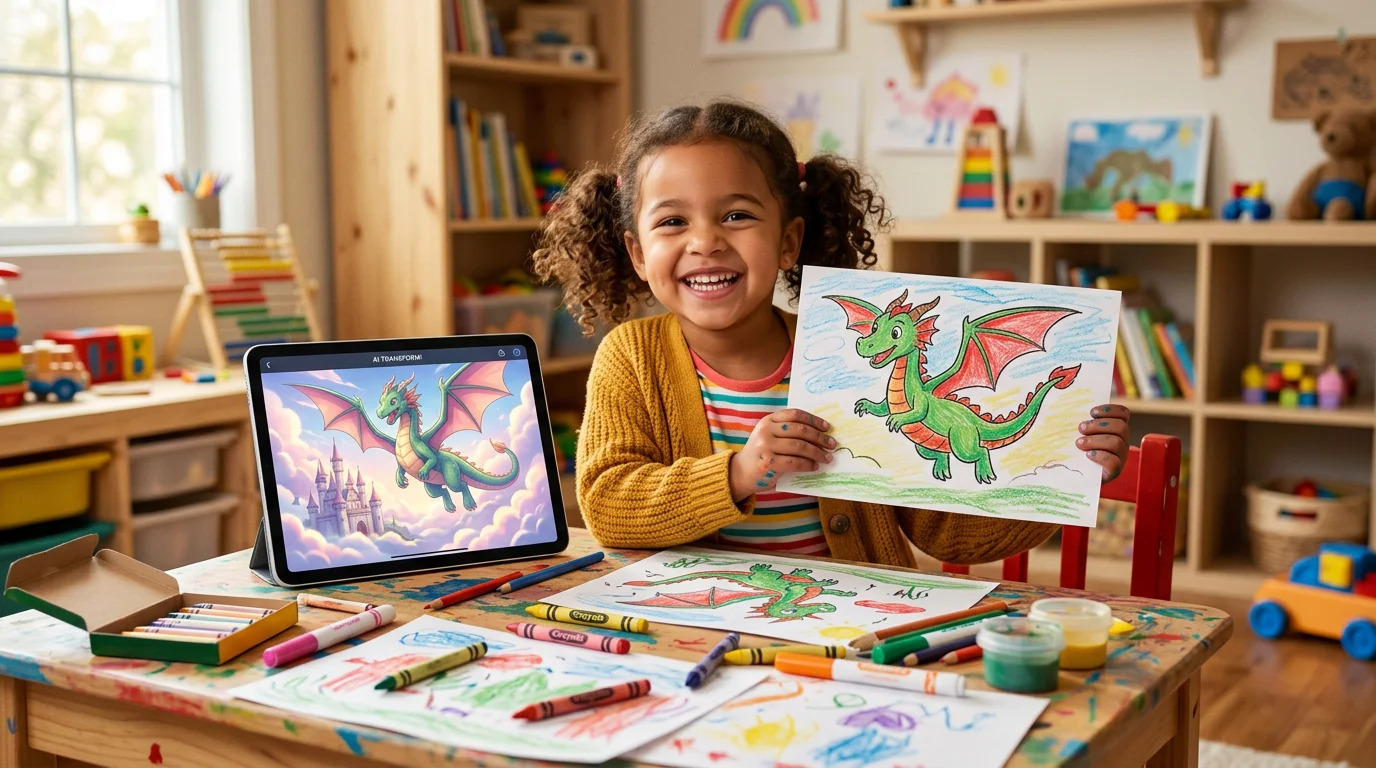
Trace and transform. Gather objects with interesting shapes — a cup, a leaf, a building block — and help your child trace around them. Then let them turn the shapes into something else. A circle becomes a face. A rectangle becomes a bus. This is the beginning of creative transformation, and it builds the same imaginative muscle that makes tools like DrawToLife so exciting for young children later on.
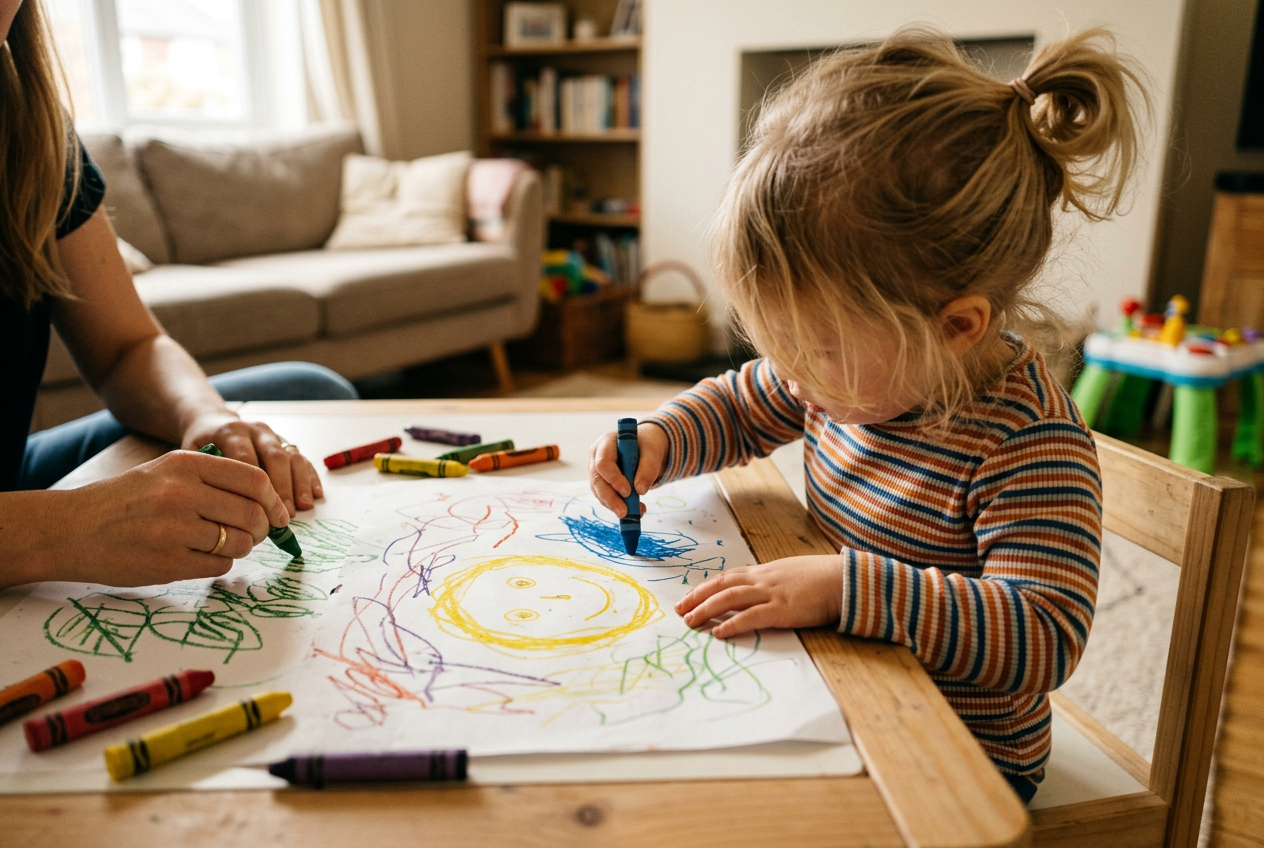
Dot-to-dot freestyle. Forget the numbered kind. Just put random dots on a page and let your child connect them however they like. Every version is different, every version is right. It’s a brilliant way to practise pencil control without the frustration of trying to draw something specific.
Drawing Activities for Ages 5-6: Where Imagination Explodes
Five and six-year-olds are in the golden age of drawing. They’ve developed enough control to be intentional, but they haven’t yet developed the self-consciousness that makes older children hesitate. These drawing prompts for children at this age should feed their boundless imagination.
The “what if” game. Ask a question, then draw the answer. What if cats could fly? What if your house was made of sweets? What if you had a pet dinosaur? The wilder the question, the more engaged they’ll be. This game produces drawings that are genuinely delightful — and it teaches children that drawing is a thinking tool, not just a copying exercise.
Draw your day. At the end of the day, sit together and each draw your favourite moment. You draw yours, they draw theirs. Then compare. This is a beautiful daily ritual that builds reflection, memory, and connection. Don’t worry about skill — stick figures are perfect. What matters is the conversation that follows.
Monster factory. Each person draws a head at the top of a page, folds the paper to hide it, then passes it on. The next person draws a body without seeing the head, folds, and passes again. The last person draws legs and feet. Unfold for instant hilarity. This classic game teaches children that drawing can be collaborative, surprising, and very, very funny.
Soundtrack drawing. Put on different types of music — classical, jazz, something with a heavy beat — and draw whatever the music makes you feel. Fast, jabby marks for energetic songs. Flowing swoops for something gentle. This is one of those fun art activities at home that crosses into emotional expression, and children often produce surprisingly evocative work.
Drawing Activities for Ages 7-8: Building Skill and Confidence
Around seven, something shifts. Children start comparing their work to others and to “realistic” standards. Some begin to doubt themselves. The right drawing activities for kids at this age balance skill-building with creative freedom, keeping the joy alive while helping them grow.
Observational drawing — but make it fun. Rather than “draw this apple,” try “draw your shoe without looking at your paper” (blind contour drawing). Or “draw your pet in exactly 60 seconds” (speed sketching). Or “draw your breakfast from memory.” These constraints take the pressure off perfection because the rules themselves make perfection impossible. Children laugh, relax, and often produce their most expressive work.
Comic strip challenge. Give your child a simple scenario — “a cat goes to space” or “a pirate finds something unexpected” — and ask them to tell the story in four panels. This introduces sequencing, character consistency, and visual storytelling. Many children who think they “can’t draw” discover they can absolutely tell a story through pictures, which is a powerful confidence boost.
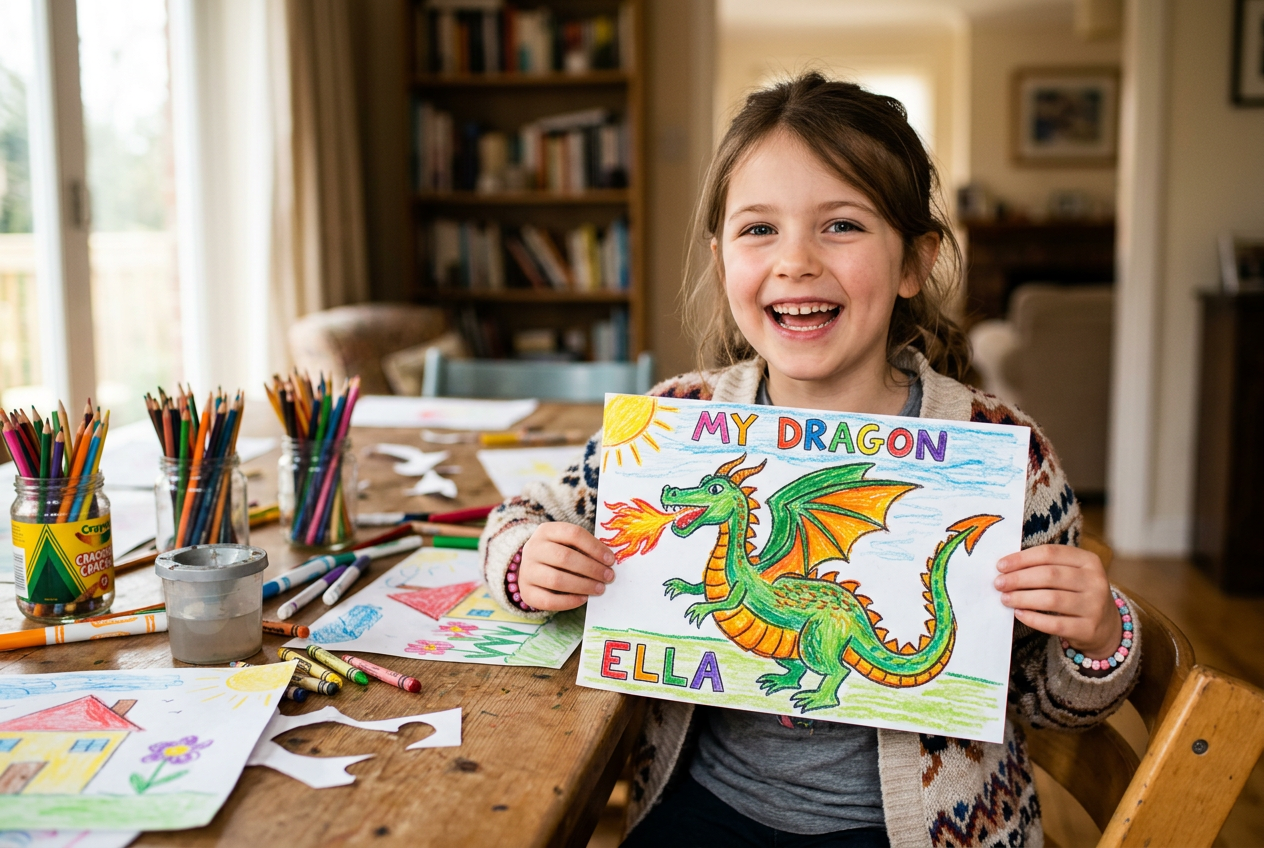
Finish this drawing. Draw a single line, shape, or squiggle on a page and challenge your child to turn it into something. A wavy line becomes a snake, a mountain range, or a sleeping dragon. A triangle becomes a wizard’s hat, a slice of pizza, or a rocket. This is creative thinking made visible, and it works brilliantly as a quick five-minute activity or a longer exploration.
Style experiments. Show your child the same subject drawn in different styles — a cartoon cat versus a realistic cat versus an abstract cat. Then let them try their own versions. This teaches children that there’s no single “right” way to draw, which is precisely the lesson that keeps them drawing through the self-conscious years. It’s also the principle behind AI art tools that help kids express their creativity in multiple styles.
Drawing Games the Whole Family Can Play
Some of the best drawing activities aren’t age-specific — they work for everyone from three to adult, which makes them perfect for family time.
Pictionary with a twist. Instead of guessing what someone is drawing, everyone draws the same word simultaneously, then compares results. A five-year-old’s “elephant” looks nothing like a parent’s, and that’s the whole point. Everyone’s version is valid. Everyone laughs. Everyone draws more.
Exquisite corpse. Similar to the monster factory above, but with more players and more elaborate results. This surrealist drawing game has been sparking creativity since the 1920s, and it works just as well at a kitchen table in 2026 as it did in a Parisian cafe a century ago.
Drawing dictation. One person describes something — “a house with a round door, three windows, and a chimney with smoke coming out” — and everyone else draws it from the description alone. The results are always wildly different, which teaches children that interpretation is a creative act and that following instructions still leaves room for personal expression.
Keeping the Spark Alive: Tips That Actually Work
The activities above are starting points. Here’s what makes them stick:
Keep supplies visible and accessible. A dedicated art corner — even just a shoe box of crayons on a low shelf — sends the message that drawing is always an option. Research suggests children draw more when materials are within reach, not packed away in a cupboard.
Join in. Children draw more (and for longer) when a parent draws alongside them. Your skill level is irrelevant. What matters is your presence and your willingness to try. Drawing together turns an activity into a relationship.
Respond to the story, not the skill. When your child shows you a drawing, resist the urge to evaluate it. Instead of “that’s beautiful” or “what is it?”, try “tell me about this.” The conversation that follows is where the real magic happens — the drawing is just the door.
Rotate activities. The same prompt every day gets stale. Keep a list of drawing prompts for children on the fridge and pick a new one when inspiration runs low. Even cycling through the ideas in this post gives you weeks of material.
Celebrate the process. Display works-in-progress, not just finished pieces. Talk about how much fun you had drawing, not just how the result looks. This builds intrinsic motivation — your child draws because they enjoy it, not because they want praise.
The Best Drawing Activity Is the One They’ll Actually Do
There’s no perfect drawing curriculum for young children. The best drawing activities for kids are the ones that get paper on the table and crayons in hands — the ones that make your child say “can we do that again?”
Start with one idea from this list tonight. Draw alongside your child for ten minutes. See what happens. You might end up with a scribble monster, a four-panel comic about a space cat, or a soundtrack painting that looks like joy feels.
Whatever you end up with, you’ll have something no worksheet or screen can replicate: a moment of shared creativity that your child will carry with them long after the crayons are put away.