How to Explain AI to Kids: A Simple Parent's Guide
She was four and a half, in pyjamas, eating toast over the sink, when she squinted at the smart speaker on the windowsill and asked, quite seriously, “Mum, is that lady inside the box, or is she on holiday?” I laughed, because of course I did, and then I realised I had absolutely no idea how to answer her. Because the lady is not in the box. There is no lady. There is a model, trained on a great deal of recorded speech, generating a plausible response to my daughter’s question about whether pigeons have ears. None of which, you may have noticed, is a useful sentence to say to a four-year-old eating toast.
If you have ever fumbled a moment like that, you are not alone. Asking how to explain AI to kids has quietly become one of the most googled parenting questions of the decade, and for very good reason. Children aged three to eight are growing up with artificial intelligence baked into nearly every device they touch — the speakers, the search bar, the camera, the bedtime-story app, the drawing toy on the tablet. They have noticed. They have questions. And the way we answer those questions, in those small kitchen-table moments, quietly shapes how they think about the technology they will use for the rest of their lives.
The good news is you do not need a degree in computer science to do this well. You need a small handful of honest, age-appropriate analogies, a few sentences to keep in your back pocket, and the willingness to say “I don’t know, let’s wonder about that together” more often than you might expect.
Why explaining AI to young children matters now
A decade ago, AI was a science-fiction word. Today it is in the recipe app, the photo library, the customer service chat, the school’s reading platform and the dragon-drawing toy on the rainy-day shelf. Researchers studying children and technology — including work coming out of MIT’s Personal Robots Group and the EU’s Joint Research Centre — have found that even very young children form intuitive theories about how digital tools work, and they form them whether or not we are part of the conversation.
Left to their own devices, young children tend to assume one of two things about AI: either it is a magic friend who knows everything, or it is a hidden person watching from inside the device. Both ideas are sticky. Both can quietly affect how a child treats their privacy, how much they trust an answer, and how proud they feel of the work they do with these tools. Helping your child build a slightly more accurate mental model, early and gently, is one of the kindest things you can do for their future relationship with technology.
It also makes everyday life easier. A child who has the words “the computer is making a really good guess” can hold that thought when the speaker mishears them, when the photo app mislabels Granny as a dog, or when the drawing app turns their crayon dragon into something glorious. The mystery becomes interesting rather than alarming.
The one analogy that works for almost every age
If you only remember one thing from this guide, remember this. The most useful, most honest way to explain artificial intelligence to a young child is to call it a really good guesser that has seen a lot of pictures and read a lot of books.
That sentence does an astonishing amount of work. It tells the truth — modern AI systems are, at their core, statistical models that predict what is most likely to come next. It removes the magic without removing the wonder. It puts the child in the position of someone who can also guess, which is empowering rather than passive. And it sets up every follow-up conversation you might ever have about why AI sometimes gets things wrong, why it shouldn’t be trusted blindly, and why their own brain is still the most important one in the room.
From there, you can branch into whatever your child is curious about. The smart speaker is “a guesser that listens for words it knows.” The photo app’s face recognition is “a guesser that has looked at lots and lots of faces.” A kids’ AI art tool like DrawToLife is “a guesser that has seen millions of paintings and is trying to guess what your drawing would look like as one.” The structure stays the same. The detail changes.
Age-by-age scripts you can actually use
Different ages need different depths of explanation. Here is roughly what tends to land, based on developmental research on how children form mental models of technology.
Ages 3 to 4: it’s a clever helper, not a person. At this age, you are not really teaching AI literacy — you are gently correcting the magical-thinking default. The phrase that works: “It’s a clever helper inside the computer. It isn’t a real person. It only knows what people have taught it.” Keep it short, keep it warm, and don’t worry about getting into how it learns. The goal is simply to plant the idea that it is a thing, not a someone. If they ask whether the helper has feelings, you can say, “No, sweetheart — it’s a bit like a very fancy calculator. It can do clever guessing, but it can’t feel happy or sad.”
Ages 5 to 6: it’s a guesser that has seen a lot. Five- and six-year-olds love patterns and rules, so this is the perfect age for the “really good guesser” analogy. Try: “AI is a kind of computer programme that has looked at lots and lots of pictures and listened to lots and lots of words. Then when you ask it something, it makes its best guess. Sometimes it’s brilliant. Sometimes it’s a bit silly. That’s why we always check.” This is also the age to start introducing the idea that AI can be wrong. Children this age tend to trust devices completely, and a small, repeated phrase — “the computer is just guessing, what do you think?” — does wonders.
Ages 7 to 8: it learns from examples, like you do. By seven or eight, children can hold a more nuanced picture. You can begin to talk about training: “People show the AI lots of examples — like millions of drawings of cats. After a while it gets very good at recognising cats, or even drawing new ones. But it can only know what it has been shown. That’s why it sometimes makes mistakes — and why your imagination is still better at coming up with completely new things.” This age can also handle a small, important caveat: AI sometimes gets things confidently wrong, and grown-ups need to double-check anything that really matters.
What to skip (for now)
There are a few topics it is genuinely fine to leave for later. You do not need to explain neural networks, training data, or large language models to a five-year-old. You do not need to introduce the idea of bias, hallucination, or deepfakes to a three-year-old. And you do not need to frighten any of them with worst-case scenarios about misuse — children are excellent worriers and tend to inflate vague threats into bedtime fears.
What you can quietly skip without losing anything important:
- Technical terminology. “Algorithm,” “model,” “training data” — useful for you, unhelpful for a six-year-old. Stick with “guesser” and “examples.”
- Doom-laden framing. “The robots are taking over” is great cinema and terrible parenting. Keep the tone curious, not catastrophic.
- Adult-level safety conversations. The detailed talk about deepfakes, scams and AI-generated misinformation can wait until eight or nine, when they can hold the nuance without becoming anxious. (For younger ages, our short parent’s safety checklist for AI art apps is a calmer place to start.)
Three small habits that build AI literacy quietly
You do not need to schedule a Saturday morning lesson on artificial intelligence. The conversations that stick are the small, repeated ones that happen alongside ordinary life.
Narrate the guessing out loud. When the smart speaker mishears, when the photo album puts a label on a picture, when the spell-checker underlines something — say what is happening. “It’s guessing. It’s not very sure about that one.” Children absorb this faster than any sit-down explanation.
Ask “where did that come from?” together. When an AI tool produces something — a story, a song, an image — pause and wonder aloud where it might have learned it. “I wonder how many cats it had to look at before it could draw one this fluffy.” This single habit gently introduces the idea of training data without ever using the phrase.
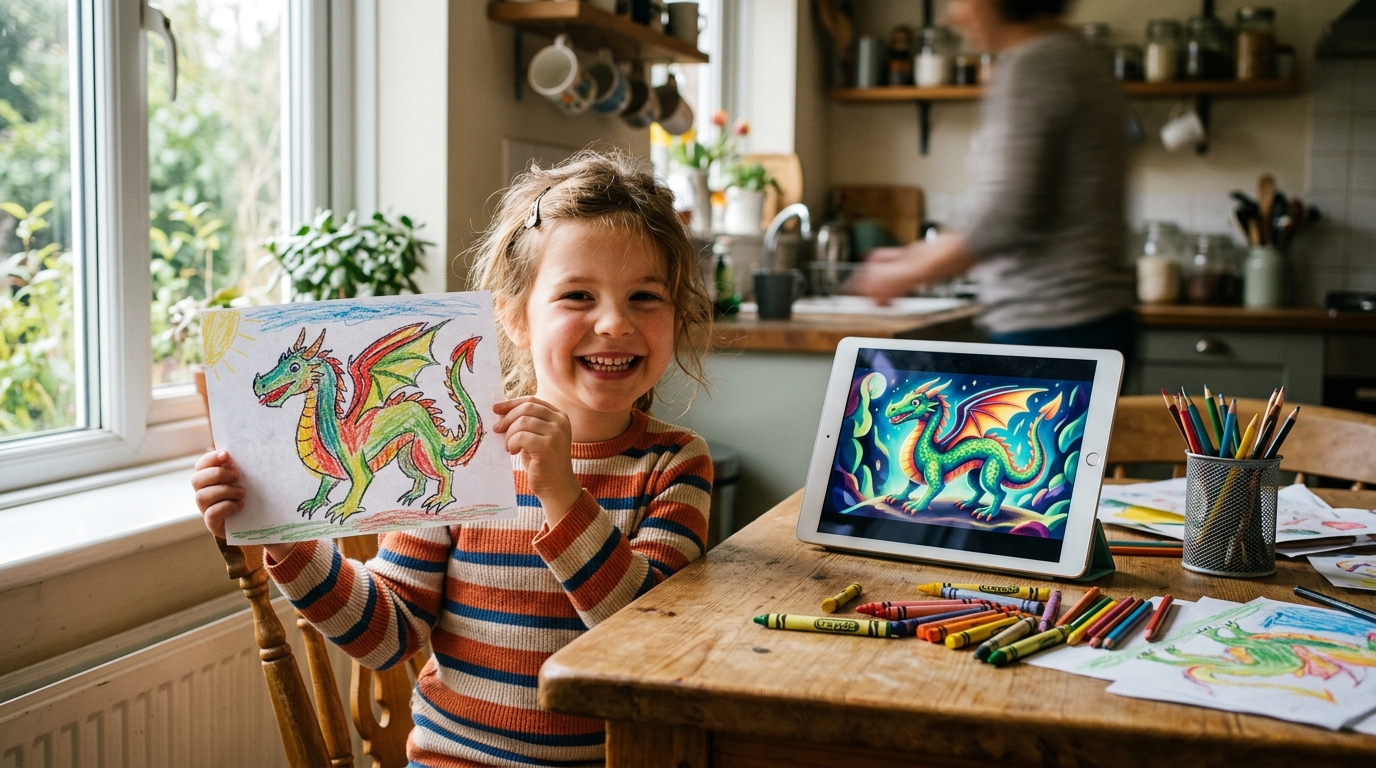
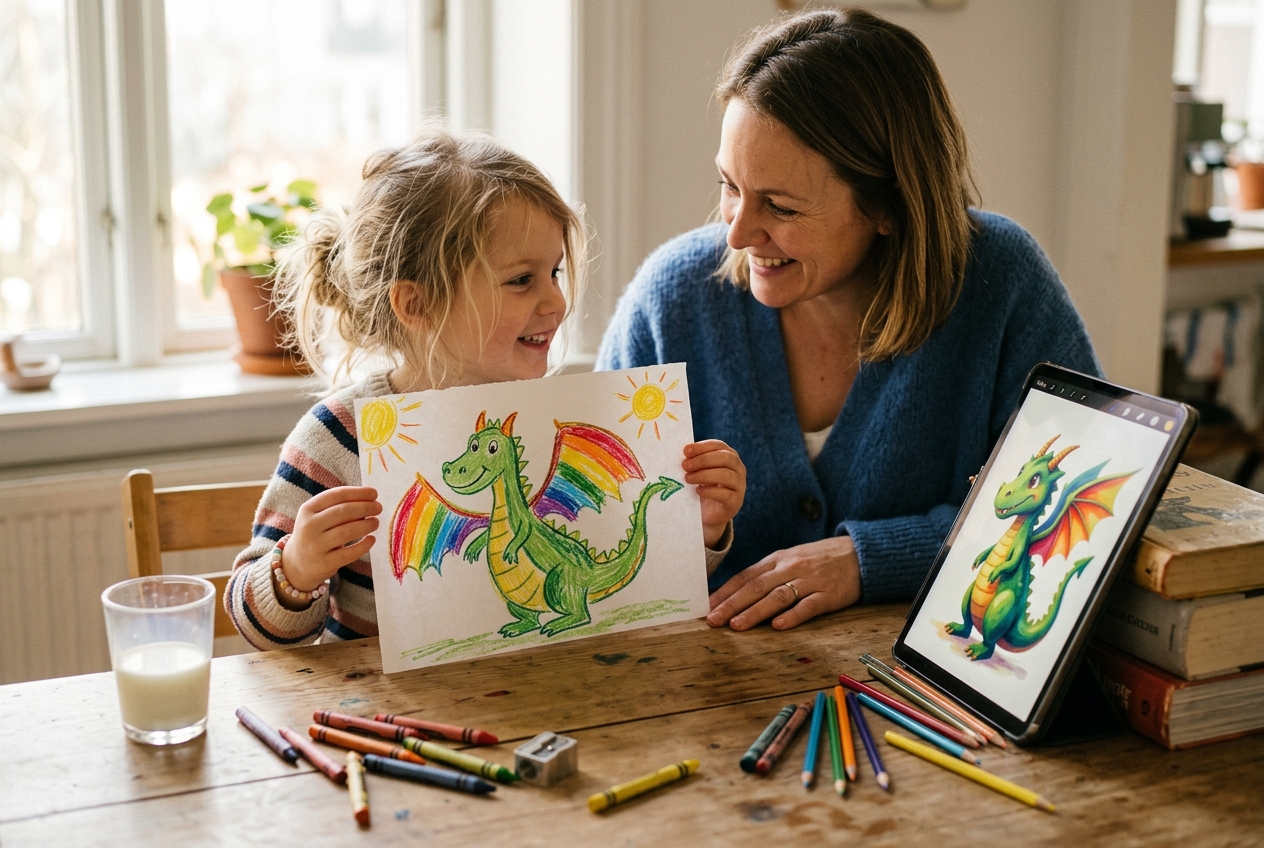
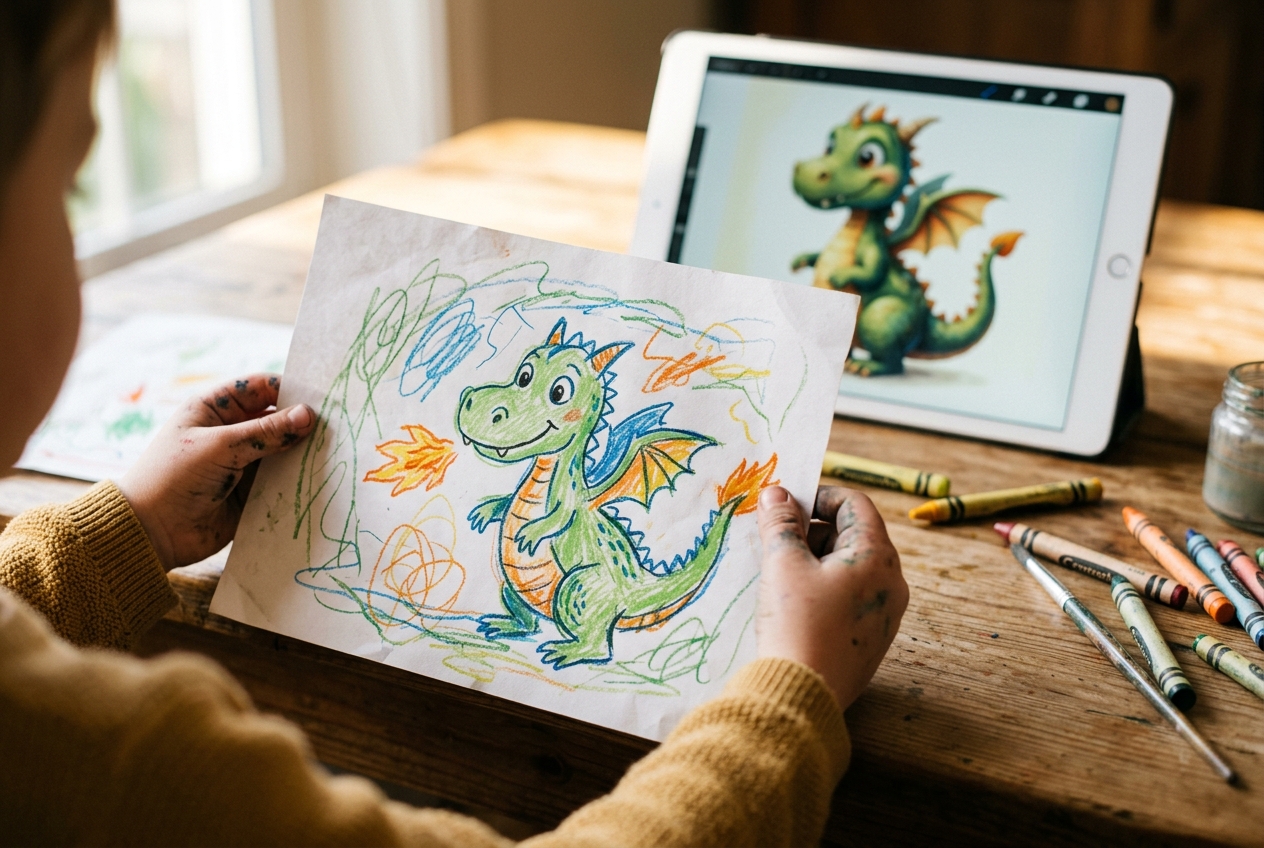
Always centre your child’s own thinking. When a child uses an AI tool to make something — and they will, because they are growing up with these tools — make sure the conversation ends with their imagination, not the machine’s output. “The computer made it look fancy, but the dragon was your idea. The wings were your idea. The fire-that-tastes-like-strawberries was your idea.” Tools like DrawToLife are designed around exactly this principle: the child draws, the AI polishes, and the credit stays where it belongs.
When your child asks the big questions
Sooner or later — and usually at bath time, because that is the law — your child will ask one of the harder questions. Is the computer alive? Does it have feelings? Could it learn to be my friend? Will it remember me? These are not silly questions. They are the same ones philosophers have asked for fifty years, just in a damper voice.
A few gentle phrases to keep ready:
- Is it alive? “No, lovey. It’s a very clever programme, but it doesn’t breathe, eat, or feel anything. It’s a tool, like a calculator or a camera, just a much cleverer one.”
- Does it have feelings? “It can copy words like ‘I’m happy,’ but it doesn’t actually feel happy. People feel things. Computers just sort information.”
- Will it remember me? “Some apps remember a little bit, and some forget the moment you close them. We always check before we tell a computer anything important about ourselves.”
- Could it be my friend? “Friends are real people who care about you. The computer is a useful helper, but it can’t care. Your real friends are the ones who’ll come to your birthday.”
You do not need to memorise these word-for-word. The tone matters more than the script. Calm, honest, slightly curious — the same way you would talk about how a fridge works, or where the moon goes during the day.
The bigger picture
The children we are raising now will be the first generation to grow up with artificial intelligence as ambient as electricity. Whether that turns out to be a quiet superpower or a quiet anxiety for them depends, in part, on the casual, kitchen-table conversations we are having with them at three, five and seven. Not the big set-piece talks. The small ones, in pyjamas, over toast.
You will not get it perfect. Nobody is. The lady-in-the-box question caught me completely off guard, and the answer I eventually mumbled — something about “a clever computer programme that listens for words” — was clumsy and incomplete and did the job anyway. Children do not need perfect explanations. They need honest ones, repeated gently, in the language of the age they are right now.
So the next time a small voice asks where the picture came from, or how the speaker knew, or whether the drawing app is a magician — take the question seriously. Sit down. Borrow the guesser analogy if you like. And if you would rather show than tell, fetch a crayon, draw something together, and let your child watch their own work being turned into art on a tool built for kids their age. That is AI literacy at its loveliest: hands sticky with felt-tip, a tablet propped against the milk jug, and a child who is starting to understand that the magic was theirs all along.