Father's Day Drawing Gifts From Kids: 12 Heartfelt Ideas
It is the Saturday before Father’s Day and my brother-in-law is standing in the kitchen, holding a slightly crumpled piece of A4 paper at arm’s length like a museum curator. On it, in green felt-tip, is a drawing of him. The head is enormous. There are seven fingers on one hand. His tie, for reasons known only to a four-year-old, is on fire. Under the drawing, in wobbling capitals, it says “DAD IS THE BEST AT BARBECUES.” He has been staring at it for a full minute. When I tease him, he shrugs and says, very quietly, “I’m going to keep this one in my drawer at work.”
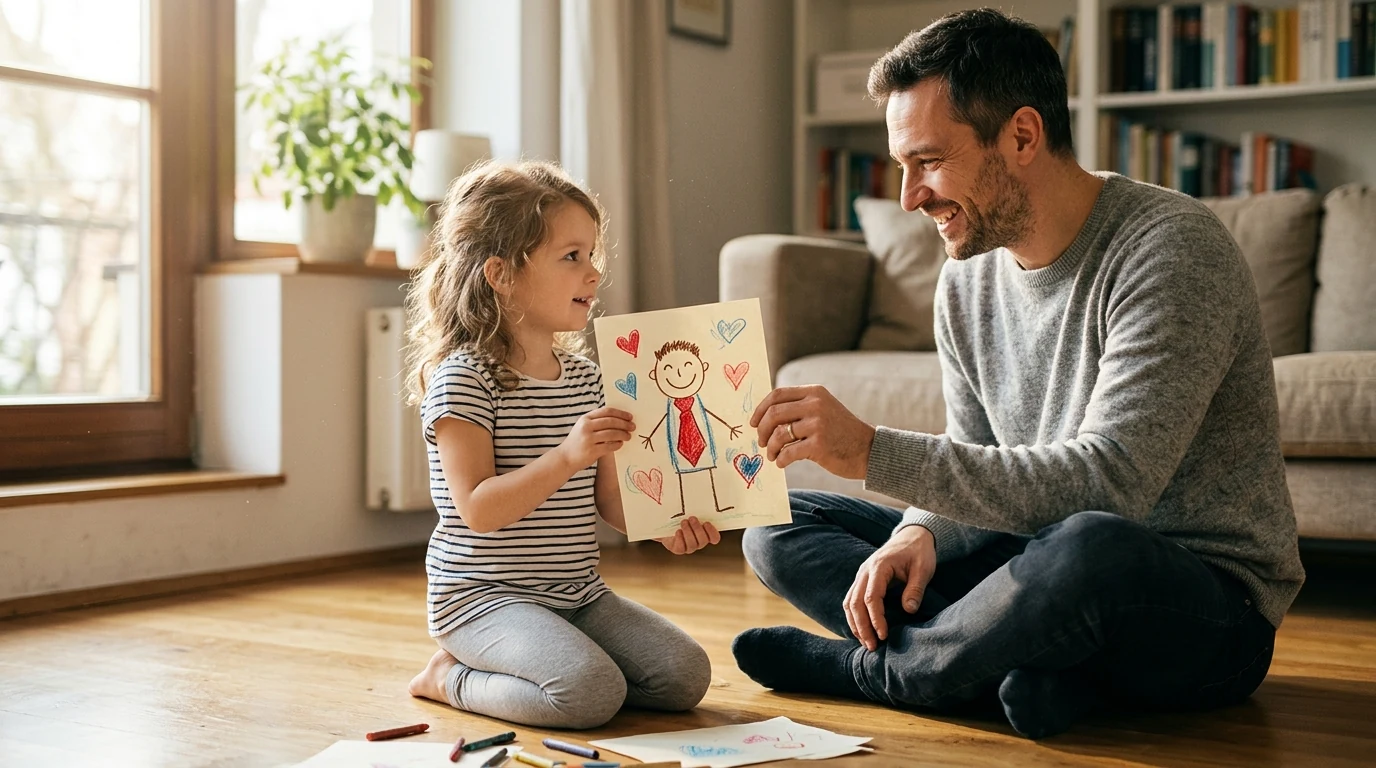
That is what is actually going on with Father’s Day drawing gifts from kids. Dads — and grandfathers, and uncles, and step-dads, and any grown-up a child has chosen to draw for — almost always keep them. A shop-bought card costs five pounds and gets recycled by July. A wonky portrait with a tie on fire ends up in a desk drawer for fifteen years. If you have a child between three and eight and roughly forty minutes of kitchen-table time before the big day, you already have everything you need.
What follows is a gentle, age-aware menu of twelve ideas, with notes on what tends to land well at each stage, how to frame the activity so it feels like fun rather than homework, and what to do with the finished thing so it does not end up wedged behind the toaster.
Why a hand-drawn gift hits harder than anything shop-bought
There is a small but lovely body of research on what psychologists call “effort-based gifts” — gifts that visibly carry the time and intention of the maker. A 2018 study from Carnegie Mellon found that recipients consistently rated handmade and effort-heavy gifts as more meaningful than equivalently priced shop-bought ones, even when they admitted the shop-bought option looked nicer. The effort itself was the message.
For children, the maths is even simpler. A four-year-old who spends fifteen minutes drawing Dad is not making a card. She is paying attention to him. She is studying the colour of his eyes, the shape of his beard, the way his glasses sit slightly crooked. That focused, observational attention is the gift. The paper is just the receipt.
This is also why “I’m rubbish at drawing” should never come into it. The point of these projects is not artistic merit. The point is the moment of looking, choosing, and giving — three things young children are quietly brilliant at, given the chance.
What kids can realistically make, by age
Before the list, a quick reality check by stage. Matching the project to the child saves everyone from the tearful “mine looks wrong” moment that haunts so many craft afternoons.
Ages 3-4 are firmly in what developmental researchers call the pre-schematic stage. Faces tend to be circles with stick limbs sprouting straight from the head, and that is exactly right for their age. Pick projects with a strong physical element: handprints, thumbprints, big-paper scribbles. Avoid anything that asks for accurate likeness.
Ages 5-6 are starting to draw people with bodies, often with very specific details (Dad’s bald patch, the cat’s missing ear). They can follow a simple structure — “draw three things Dad loves” — but get frustrated if asked to draw too realistically. Lean into colour, story, and silliness.
Ages 7-8 can plan a small project across multiple pages. Comic strips, story books, and “menus” all work beautifully. They also start caring more about how the finished thing looks, so a small amount of grown-up help with mounting or framing makes a real difference.
If you want to go deeper on what’s happening at each stage, our piece on children’s drawing development stages walks through it in proper detail.
12 Father’s Day drawing gift ideas kids can actually make
1. The “Why I Love Dad” mini comic
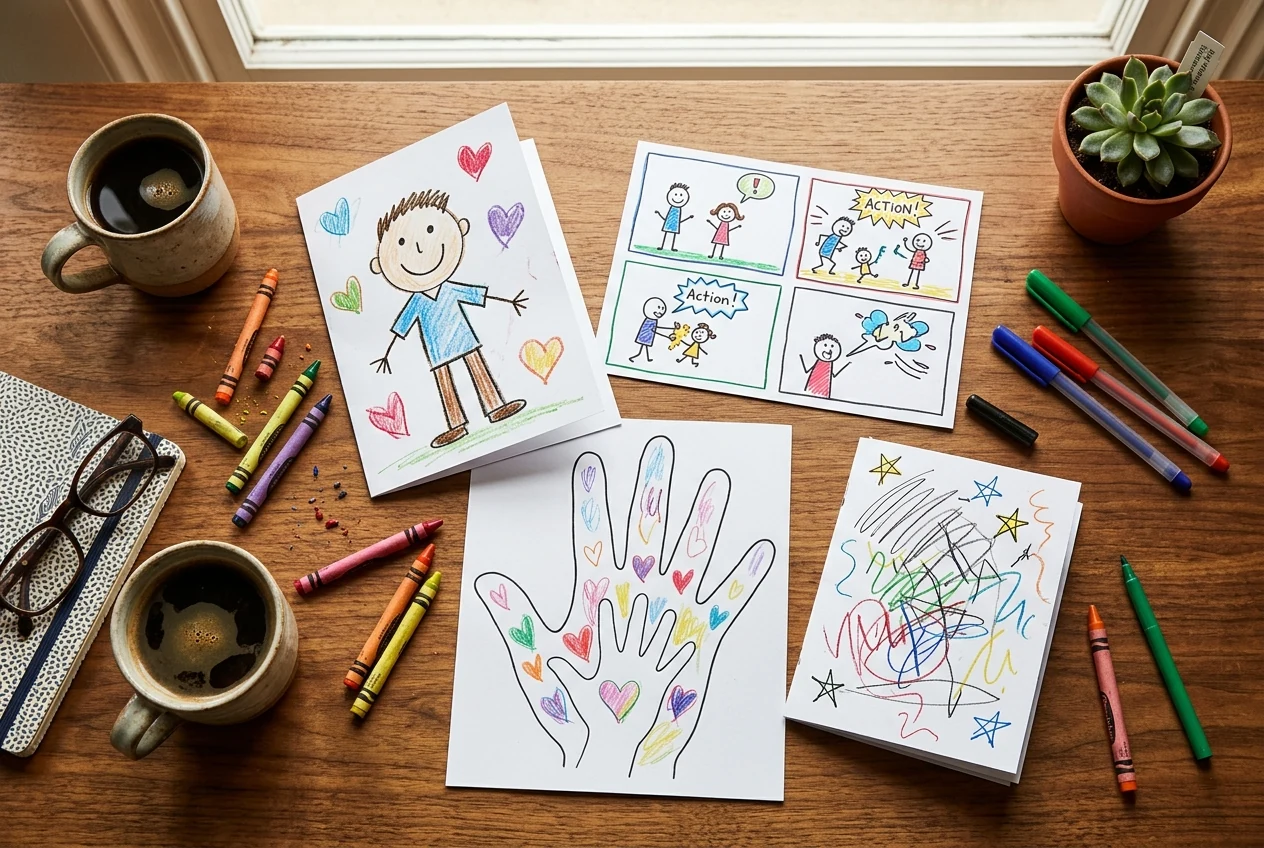
Fold an A4 sheet into four panels. Ask your child for four reasons they love Dad, then draw one in each box. The reasons will be magnificent. (“He lets me have ice cream in the bath.” “He smells like the car.” “He is very tall for sitting on.”) Best for ages 5-8.
2. A portrait with three favourite things
A drawing of Dad, surrounded by three things he loves. The choice is the magic. A five-year-old will fiercely defend that Dad’s three favourite things are coffee, the lawnmower and her. She is, of course, completely correct. Best for ages 4-7.
3. A drawn map of “our places”
A simple map of the places Dad and child go together — the park bench they sit on, the cafe with the good biscuits, the bit of the garden where the football lives. Hand-drawn maps are deeply personal and almost impossible to throw away. Best for ages 6-8.
4. The superhero poster
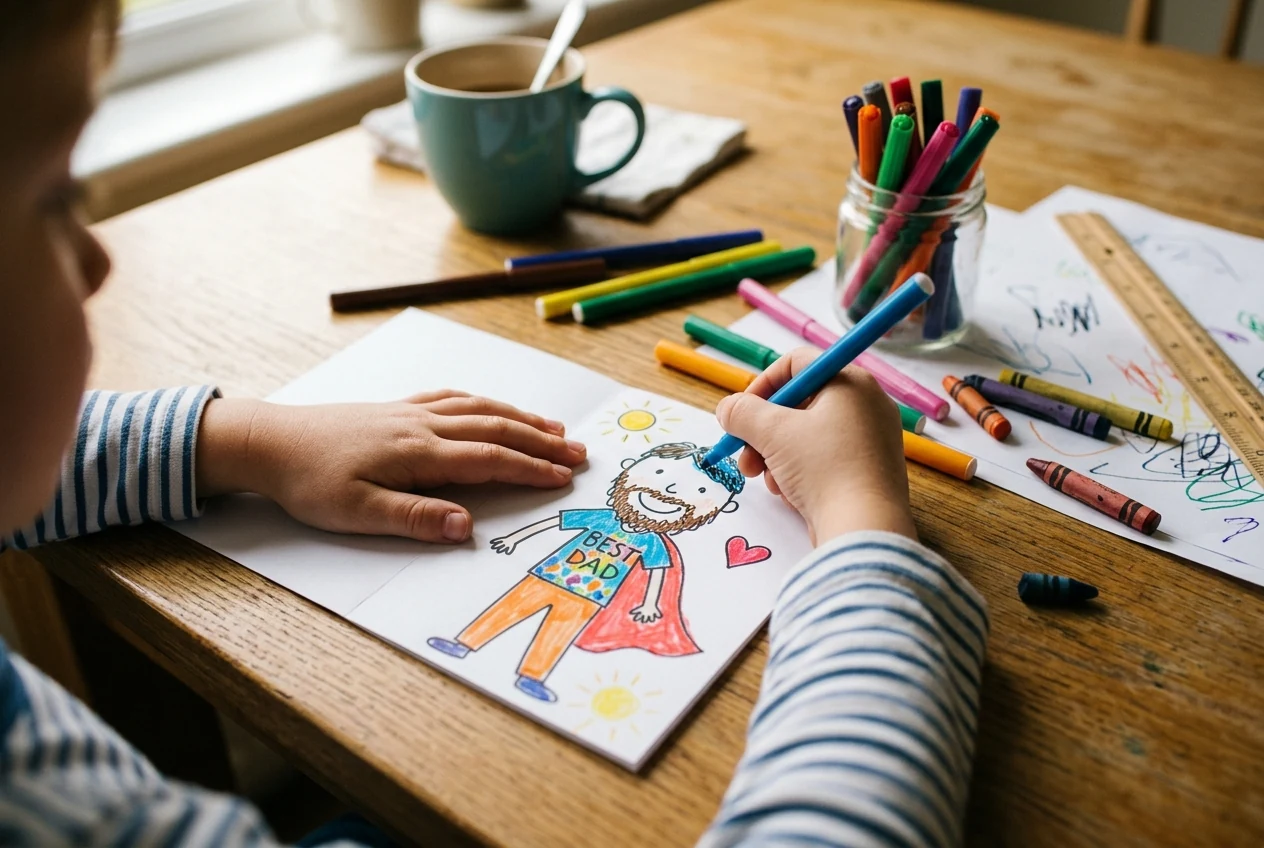
What is Dad’s superpower? Carrying all the shopping in one go? Reaching the high shelf? Knowing exactly how the toaster works? Draw him in a cape, in action. Mum can write the superhero name underneath. Best for ages 4-7.
5. A thumbprint family tree
Press tiny inked thumbs onto a sheet of paper, then turn each thumbprint into a person — Dad, Mum, child, siblings, pets. A surprisingly tender project that doubles as a keepsake the size of a postcard. Best for ages 3-5.
6. Hand-traced “Dad and Me” portrait
Trace Dad’s hand, then trace the child’s hand inside it. Decorate both. The size difference does most of the emotional work — when Dad opens it, he sees a tiny hand cradled inside his own. Best for ages 3-6.
7. A coupon book of drawn promises
A small stapled book of coupons, each one a drawing of something the child promises Dad. “One quiet morning.” “One car wash with the hose.” “Three hugs, any time.” Dads tear these out years later and still remember them. Best for ages 6-8.
8. A drawing-letter
Half drawing, half letter. The child draws Dad on one side and dictates what they want to say on the other, with a grown-up scribing. Use the child’s own words exactly — wobbly grammar and all. The phrases that sound funny now will be the ones that catch in Dad’s throat in twenty years. Best for any age.
9. The “Dad and Me” storybook
Three or four pages, stapled into a tiny book. Each page a moment — the day Dad fell off the paddleboard, the time he made pancakes shaped like cats, the trip to the beach. Older children can write the captions themselves. Best for ages 6-8.
10. A drawn frame around a real photo
Print a favourite photo of Dad and child. Glue it to the centre of a larger piece of paper. Let the child decorate the border with drawings, hearts, scribbles, dragons — whatever fits the mood. The result is a one-off frame that no shop can sell. Best for ages 4-8.
11. A breakfast menu
Fold a sheet into a menu shape. The child draws and “writes” the breakfast they are going to make Dad on Father’s Day morning, prices included. (“Toast — three pounds. Smile — free.”) Bonus points for actually making it. Best for ages 5-8.
12. A family bucket list
A long sheet of paper covered in small drawings — one for every place the child wants to go with Dad before the next Father’s Day. Slightly mad. Slightly ambitious. Always loved. Best for ages 6-8.
How to give the drawing a fighting chance of lasting
Most children’s Father’s Day art does not survive the year, not because dads do not love it, but because nobody quite worked out where to put it. Twenty seconds of grown-up effort fixes this.
Mount it. A piece of coloured card cut slightly larger than the drawing makes the whole thing feel intentional. Glue stick, two minutes, done.
Frame the one. Pick the best piece and put it in a cheap frame from the high street. The frame is the message: this one is staying up.
Photograph everything. Take a clear, well-lit photo of every piece before it goes anywhere. The original will fade, get jam on it, or quietly disappear. The photo will not.
Turn the favourite into a keepsake. This is a lovely use of child-safe AI art tools. A wobbly crayon portrait of Dad scanned through something like DrawToLife can be transformed into a polished version — animated, watercoloured, or rendered in a Pixar-ish style — without losing the lopsided ears or the seven-fingered hand that made the original charming in the first place. Printing the original and the transformed version side by side, then framing them together, makes for the kind of gift dads quietly find an excuse to show people. If you have used the app to turn kids’ drawings into stories, the same idea works here — a tiny personalised storybook starring Dad is a remarkable thing to hand over on a Sunday morning.
A quiet note on all the dads, granddads, and other grown-ups
Not every child has a dad in the traditional sense, and Father’s Day can quietly ache for the families where things look different. Worth saying clearly: every idea on this list works just as well for a granddad, an uncle, a step-dad, a foster carer, a much-loved family friend. Children give drawings to the grown-ups who matter to them. The label on the calendar is the least important part of the day.
If your child has more than one person they want to draw for, let them. Two superhero posters in one afternoon is a fine use of a Saturday.
The morning of
Keep it small. The point of all this is not a perfect, Pinterest-worthy reveal. The point is the moment the child hands the paper over and watches the grown-up’s face. Make a cup of tea. Let your child carry the drawing in herself. Resist the urge to explain it (“She meant to draw a tie, not a snake”). Let the work speak for itself, in its own slightly bonkers language.
Dads are very, very good at receiving these gifts. They know what they are looking at. The wobbly lines, the seven fingers, the tie on fire — all of it lands exactly where it is meant to. And somewhere, six months later, when your child has long forgotten about the drawing, Dad will quietly open a drawer at work, take it out, and look at it for a full minute before getting back to whatever he was doing.
That is the gift. The paper is just where it lives.