Summer Drawing Ideas for Kids: 30 Days of Creative Fun
The first proper warm afternoon of the year, and my niece has dragged a tea towel, three felt-tip pens and a battered sketchbook to the bottom of the garden. She is six. She is “setting up a studio.” The studio consists of an upturned crate, a plastic dinosaur acting as a paperweight, and a very serious sign she has made for the gate that reads “ART ONLY.” Within twenty minutes, she has drawn the apple tree, the cat, the cat eating the apple tree, and a portrait of her brother that I am told is “for sale, ten pounds.”
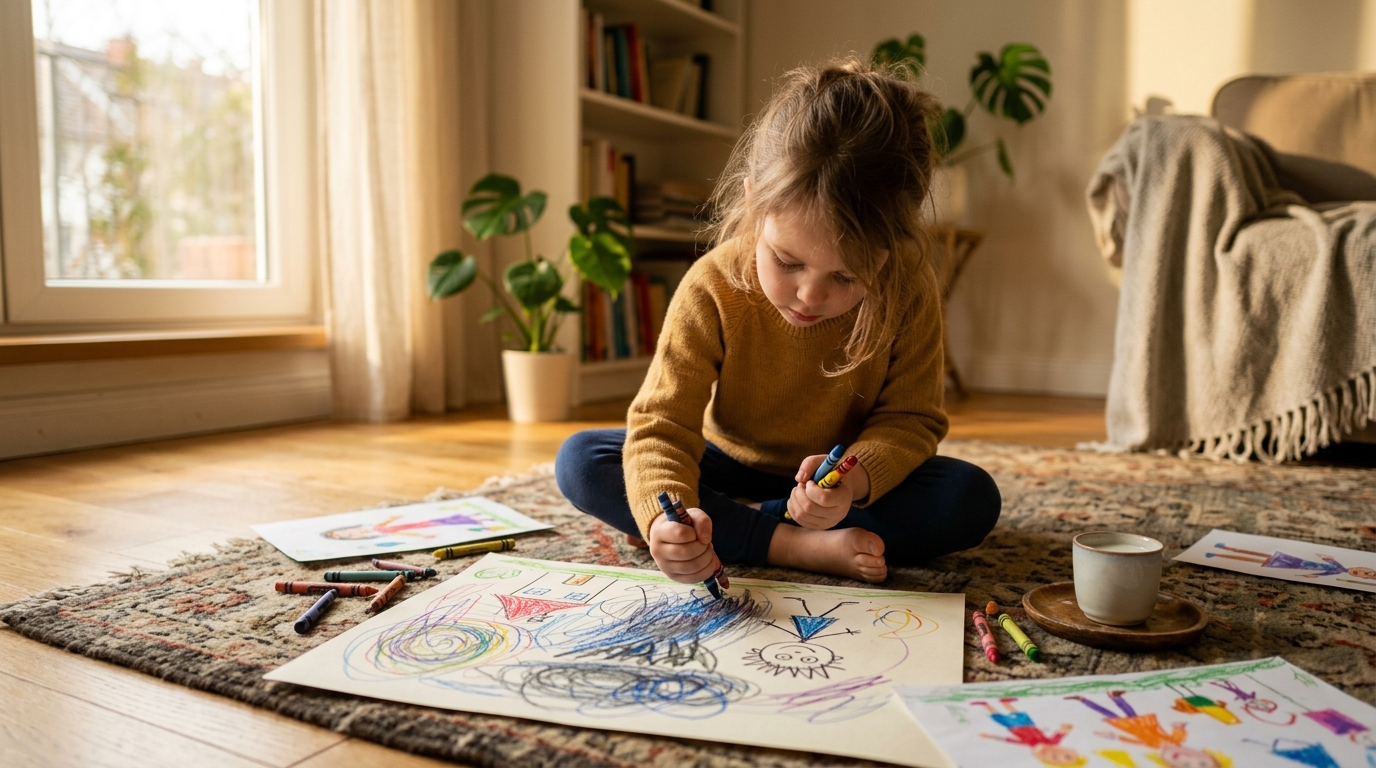
Summer does something to children and drawing. The long, slightly shapeless days that drive parents quietly mad are exactly the conditions creativity needs. Less rushing, more noticing. Kitchen tables that stay set up all afternoon. Pavements that turn into canvases the moment someone produces a tub of chalk. If you’ve been looking for summer drawing ideas for kids that don’t require buying a single new thing, this is the season for it — and a gentle, no-pressure challenge can be the loveliest way in.
Why summer is the perfect season for drawing
There’s a reason your child’s most ambitious drawings tend to appear in July and August rather than November. The school year, for all its brilliance, is structured. Days are sliced into lessons, transitions, lunch slots and after-school clubs. Children of three to eight are remarkable at making creativity fit those gaps, but they’re working against the clock. Summer removes the clock.
Developmental researchers describe young children’s creative process as deeply iterative. A four-year-old doesn’t draw a picture and then move on — she draws a picture, looks at it, adds something, narrates a story to it, redraws the bit she didn’t like, and only then declares it finished. That cycle takes time. Summer is the rare stretch of the year when that time exists in abundance.
The other quiet superpower of summer is sensory input. Warmer weather pushes children outside, and outside is where their eyes start working overtime. Bright colours, strange textures, unexpected shapes, slow-moving insects, fast-moving clouds — all of it lands as raw material that comes out in their drawings later. If you’ve ever wondered why a child’s summer holiday drawings feel more confident and more inventive than the ones they bring home in March, this is why. Their visual diet has expanded.
How to run a 30-day summer drawing challenge
A “challenge” sounds intense; it really shouldn’t be. The version that works for three- to eight-year-olds looks much more like a treasure hunt with crayons. The whole structure can fit on a single sheet of paper stuck to the fridge.
Pick a length that fits your family. Thirty days is satisfying if you have a long holiday stretching ahead, but a fortnight works just as well, and a “weekly summer prompt” is plenty if your child is on the younger end. The point is rhythm, not volume. Aim for short sessions of ten to twenty minutes — anything longer for this age group usually drifts into tantrum territory.
Keep three rules in the back of your mind. First, drawings don’t have to be finished, kept, or shown to anyone. Second, the prompt is a starting point, not an instruction — if your child wants to draw a unicorn instead of the bird in the garden, the unicorn wins every time. Third, you draw too, badly and visibly. Children of three to eight are watching grown-ups for cues about whether being rubbish at something is allowed. Showing them that it is, with your own wonky giraffe, does more than any pep talk could.
Ten outdoor summer drawing prompts
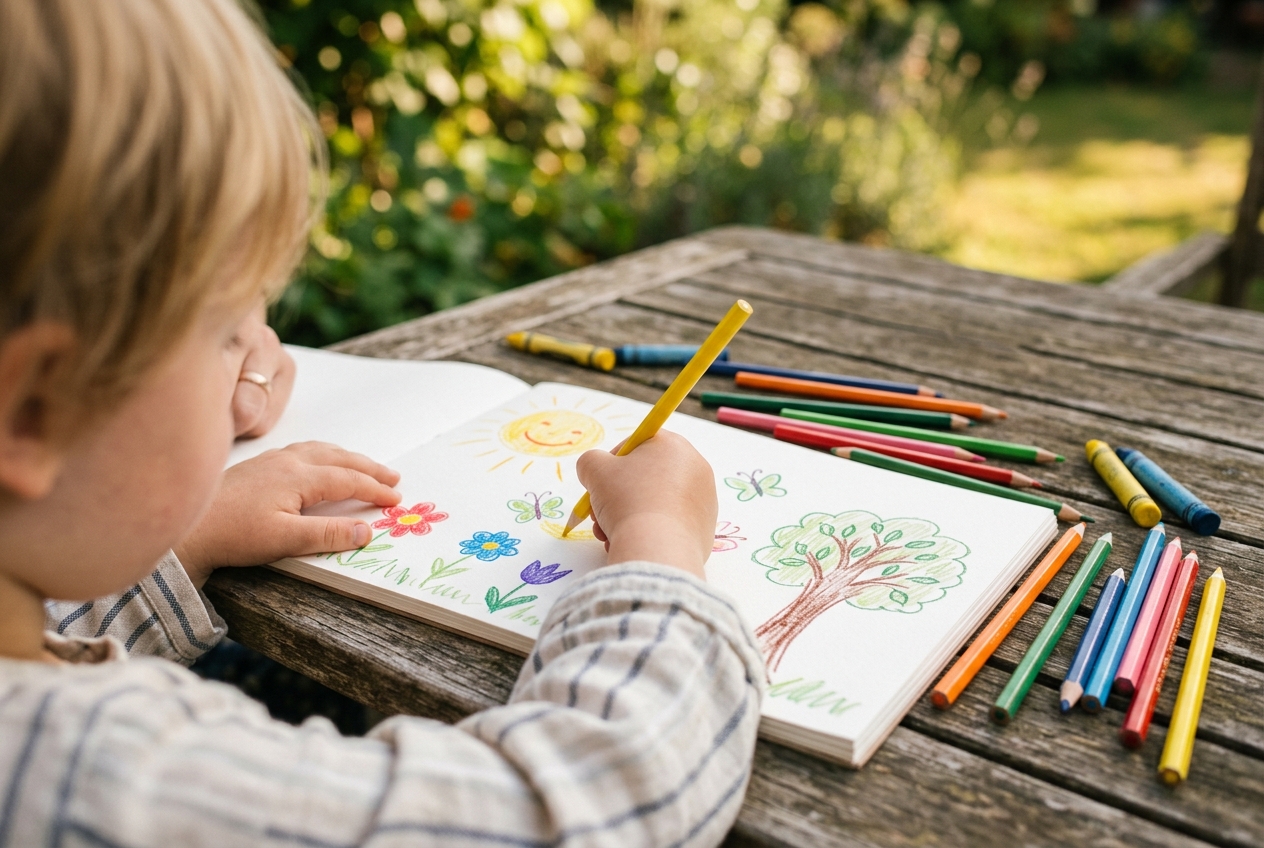
The garden, the park, the seaside — anywhere your child can sit cross-legged with a sketchbook on their knees becomes a drawing studio. These prompts work best with a small clipboard, a pencil, and one or two colouring tools rather than a full kit; less to carry, less to lose, less to argue about.
- Draw a tree from its trunk to its tallest leaf, then add a creature living in it.
- Find the smallest flower you can and draw it ten times bigger than it really is.
- Sit in one spot for five minutes, then draw everything you heard, not what you saw.
- Make a “cloud diary” — draw the shapes of three clouds and give them all names.
- Spot a bird, watch it for thirty seconds, then draw it from memory.
- Draw a pavement crack as if it’s a map to somewhere magical.
- Collect three leaves, lay them under the page, and rub a crayon over the top to reveal them.
- Draw your own shadow in chalk, then add a fancier outfit, a hat, and a pet.
- Find a puddle or pond, then draw what you imagine lives underneath it.
- Draw the sun’s face if it had a personality — grumpy, sleepy, cheeky, in love.
These work brilliantly on holiday too. A child who isn’t sure what to do with herself at the beach for the fourth hour in a row will perk up considerably the moment you suggest she’s the official illustrator of today’s “what we found in the rock pool” report.
Ten indoor summer drawing prompts for hot or rainy afternoons
Even the most golden summer eventually delivers a stretch of weather that’s too hot to be outside, or a thunderstorm that puts the garden out of action. These prompts are designed for kitchen tables, picnic blankets indoors, and the floor in front of an open window.
- Draw your favourite ice cream as a person.
- Invent a brand-new summer fruit that doesn’t exist yet — name it, draw it, slice it open.
- Draw a self-portrait but you live underwater.
- Imagine your bedroom as a jungle and draw what’s growing in the corners.
- Make a “menu” for an imaginary summer café with five drinks and five puddings.
- Draw a holiday photo of an animal who’s never been on holiday before.
- Create the world’s tallest sandcastle and put it on a map.
- Draw your family as a band, complete with summer-themed instruments.
- Design a swimming pool for a creature of your choice.
- Draw what your shadow does when nobody is looking.
Younger children — three- and four-year-olds — will need these reworded into one short sentence rather than the whole prompt, and they’ll often need you to start the page with a single squiggle they can build on. If you’d like more ideas built around prompts and shared play, our guide to drawing games for kids pairs nicely with these.
Ten imagination prompts to stretch them a bit further
These are for the days when your child has settled into the rhythm and is hungry for something more demanding. They lean a little harder on storytelling, which is exactly the cognitive workout this age group benefits from.
- Draw a postcard from a holiday on the moon.
- Invent a creature that only comes out during heatwaves.
- Draw a thunderstorm from the point of view of a worm.
- Design the bedroom of a child who lives in a lighthouse.
- Draw your own face if you grew up to be a pirate.
- Imagine summer lasted for a hundred years — draw what happens to your street.
- Design a flag for “the best day of summer.”
- Draw a butterfly that’s been collecting things — what’s in its tiny rucksack?
- Invent a summer recipe and illustrate every step.
- Draw a portrait of your future self on holiday in fifty years.
These prompts work because they ask for a story, not a picture. Children draw more confidently when the question is “what’s happening?” rather than “what does it look like?”

Keeping it pressure-free
The fastest way to derail a summer drawing challenge is to turn it into a performance. Children can sense the moment you start hoping they’ll produce something framable. They will then either freeze, refuse, or — worst of all — start drawing what they think you want to see rather than what’s in their head.
Two small habits keep the pressure off. First, treat the daily drawing as a piece of conversation rather than a finished artwork. Ask “what’s happening in this bit?” or “who’s that one?” — the kinds of open questions covered in our piece on how to talk to kids about their art. Second, build in an “abandoned drawings” box. Officially permitted half-finished pictures stop perfectionism in its tracks; children who know they’re allowed to give up are far more willing to start.
If your child loves seeing their drawings transformed — many do — a tool like DrawToLife can be a gorgeous end-of-week ritual. Pick a favourite drawing from the week, watch it turned into a polished anime, watercolour or claymation version, and stick both side by side in a summer scrapbook. It rewards the original drawing without ever asking the child to redo it.
What you’ll have at the end of summer
A scruffy sketchbook. A drawer full of curling paper. A handful of drawings on the fridge that you’ll quietly transfer to a box marked with this year’s date. And — if you’re lucky — a child who, when school starts again in September, picks up a pencil without flinching and says, “I drew loads of stuff this summer.”
That’s the actual win. Not the drawings themselves, lovely as some of them will be, but a child who’s spent thirty long, unhurried, slightly sun-warmed afternoons being reminded that their imagination is worth listening to. That’s the kind of confidence that lasts well beyond the season.
Whatever shape your summer takes — back garden, caravan park, grandparents’ kitchen, a fortnight by the sea — leave room for a sketchbook and a handful of crayons. The drawings will look after themselves.