How Drawing Helps Kids Process Big Emotions and Worries
He had been quiet at pick-up. Quieter than usual. Not the I’m-tired-and-hungry quiet, but the small, faraway quiet of a four-year-old who has been carrying something around all afternoon and doesn’t yet have the words for it. At home, I put a stack of paper and a tub of crayons on the kitchen floor, sat down nearby with a cup of tea, and said nothing. Within a minute he was drawing a huge, angry orange shape with what looked like teeth. “That’s the big noise the hand dryer made,” he said, without looking up. “It scared me.” Then he drew himself, very small, standing next to it. Then he drew the teacher’s hand on his shoulder. By the time he had finished, the orange shape had been crossed out twice and turned into a slightly friendlier-looking lion. He stood up, took the drawing to the fridge, and asked for a biscuit.
That whole quiet, miraculous process — a worry named, examined, redrawn, and packed away — is what people mean when they talk about drawing helps kids process emotions. It’s not abstract. It’s not therapy. It’s a child using their hands to do something their words can’t yet do. And the more researchers study it, the clearer it becomes that drawing is one of the most natural emotional regulation tools young children have.
Why Words Fail Young Children First
Children between the ages of three and eight live in a strange in-between. Their feelings are big, vivid, and physical — but the part of the brain that puts feelings into language is still under construction. Neuroscientists who study emotional development describe a kind of bottleneck: the limbic system, which generates emotion, develops much earlier than the prefrontal cortex and language centres, which help name and regulate it. The result is a child who can feel everything and explain almost none of it. What ends up on the page also shifts as they move through the stages of drawing development.
This is why “use your words” so often fails. The words simply aren’t built yet. But hands? Hands are ready. A crayon and a piece of paper give a young child a route around the language bottleneck. They can show what they cannot say — a stormy sky over a tiny figure, a monster under a bed, a smiling family with one person drawn slightly smaller and further away. The drawing arrives before the explanation, sometimes long before.
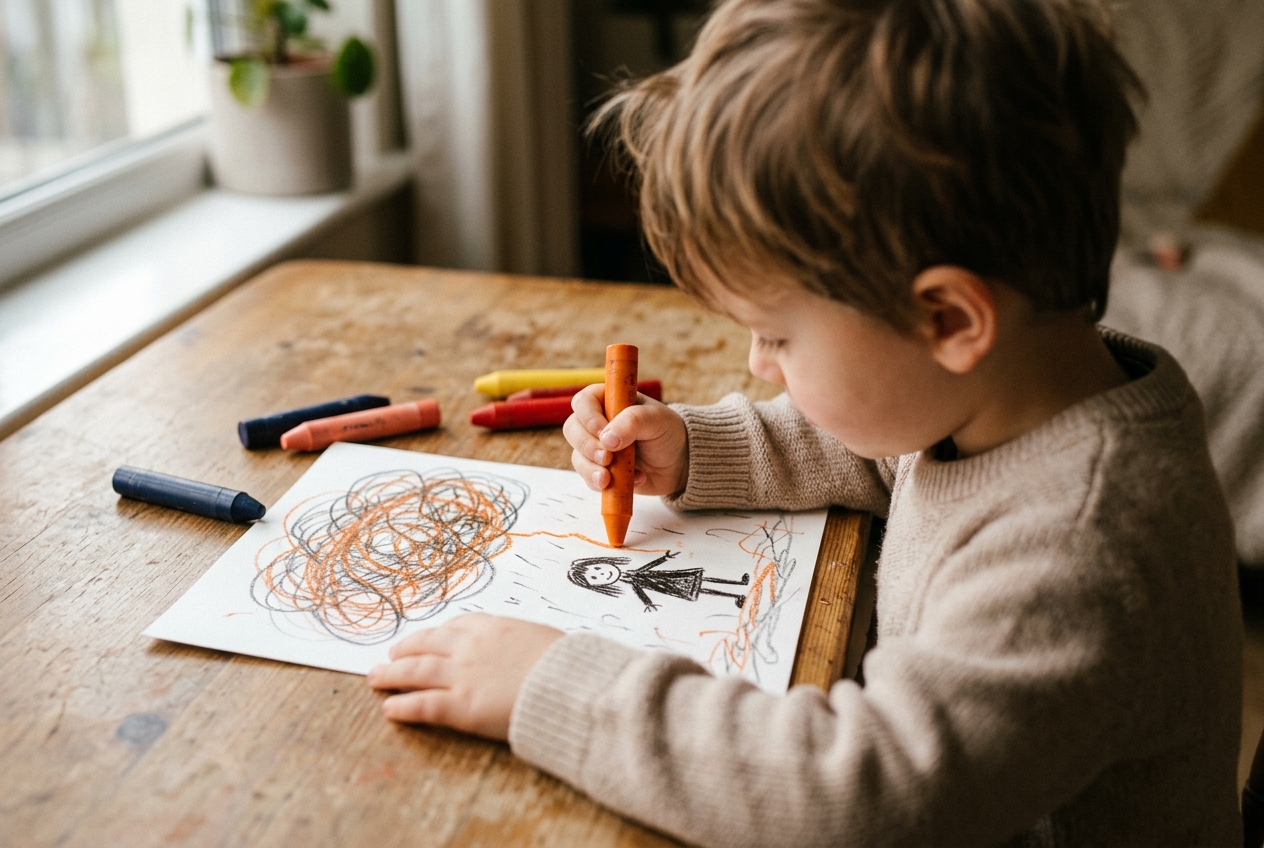
Researchers in child psychology have a clinical term for this: externalisation. When a child draws a feeling, they take it out of their body and put it on paper, where it becomes a thing they can look at rather than a thing they are inside. That small shift — from I am scared to here is the scared thing — is the beginning of regulation. It’s also the same mechanism adult therapists use, just with crayons instead of words.
What Drawing Actually Does in a Child’s Brain
The emotional benefits of drawing are not folk wisdom. Studies in developmental psychology and art therapy over the last two decades have pointed to several consistent effects in children aged three to eight.
The first is soothing through rhythm. Repetitive mark-making — circles, lines, scribbles, colouring-in — activates the same calming, parasympathetic responses as rocking, humming, or stroking a pet. A 2017 study in the journal Art Therapy found that just forty-five minutes of any kind of art-making lowered cortisol (the stress hormone) in three quarters of participants, regardless of artistic skill. For children, who don’t yet judge their own work harshly, the effect is even cleaner.
The second is emotional naming through symbols. Long before a child can say “I felt left out at nursery today,” they can draw a group of children with one figure standing off to the side. Show them their drawing an hour later and they will often tell you the whole story. Drawing acts as a slow-motion replay button for feelings the child couldn’t process in the moment.
The third is a sense of control over scary things. A child who is frightened of dogs can draw a dog the size of an ant. A child who is anxious about a hospital visit can draw the hospital with a smiley face on the door. This isn’t denial — it’s rehearsal. The drawing makes the scary thing small enough to handle, and the act of handling it builds confidence for the real encounter. If you have seen this in your own child, you have already watched emotional regulation happen in real time.
What to Notice (Without Becoming an Amateur Psychologist)
Before going further, a small but important caveat: a single drawing almost never means what a viral parenting article says it means. A black scribble does not mean your child is depressed. A small figure does not mean low self-esteem. A red-and-orange storm does not mean rage problems. Children draw what is on top of their minds in that moment, and that moment passes.
What is worth gently noticing — over weeks, not minutes — is patterns. The American Art Therapy Association is careful to say that drawings should be read as conversation starters, never as diagnoses. With that in mind, here are a few patterns parents quietly file away.
Sudden, lasting changes in colour palette. A child who used to draw in joyful rainbows and now reaches only for black or grey for weeks at a time may be telling you something about their mood. So might the reverse — a child who turns from quiet pastels to violent reds. Neither is alarming on its own; both are worth a gentle conversation.
Recurring themes. A child who draws the same monster, the same closed door, the same broken bridge, day after day, is probably working something out. You don’t need to interpret it. You just need to be near.
Where they put themselves. Children almost always include themselves in family drawings. If they don’t, or if the figure they say is them is much smaller or further from the others, that’s a quiet flag — not for alarm, but for noticing.
The art therapist’s golden rule, repeated again because it matters: never interpret a child’s drawing out loud as if you have decoded it. Ask instead.
The One Question That Unlocks Everything
If there is a single sentence worth memorising for parenting a child through big feelings, it is this:
“Tell me about your drawing.”
That sentence, said warmly and without an agenda, is the entire technique. It is open-ended, non-judgemental, and gives the child the role of expert on their own work. Compare it to the alternatives — “Is that you?”, “Why is it so dark?”, “Are you sad?” — all of which press the child toward an answer that fits the parent’s anxiety rather than the child’s truth.
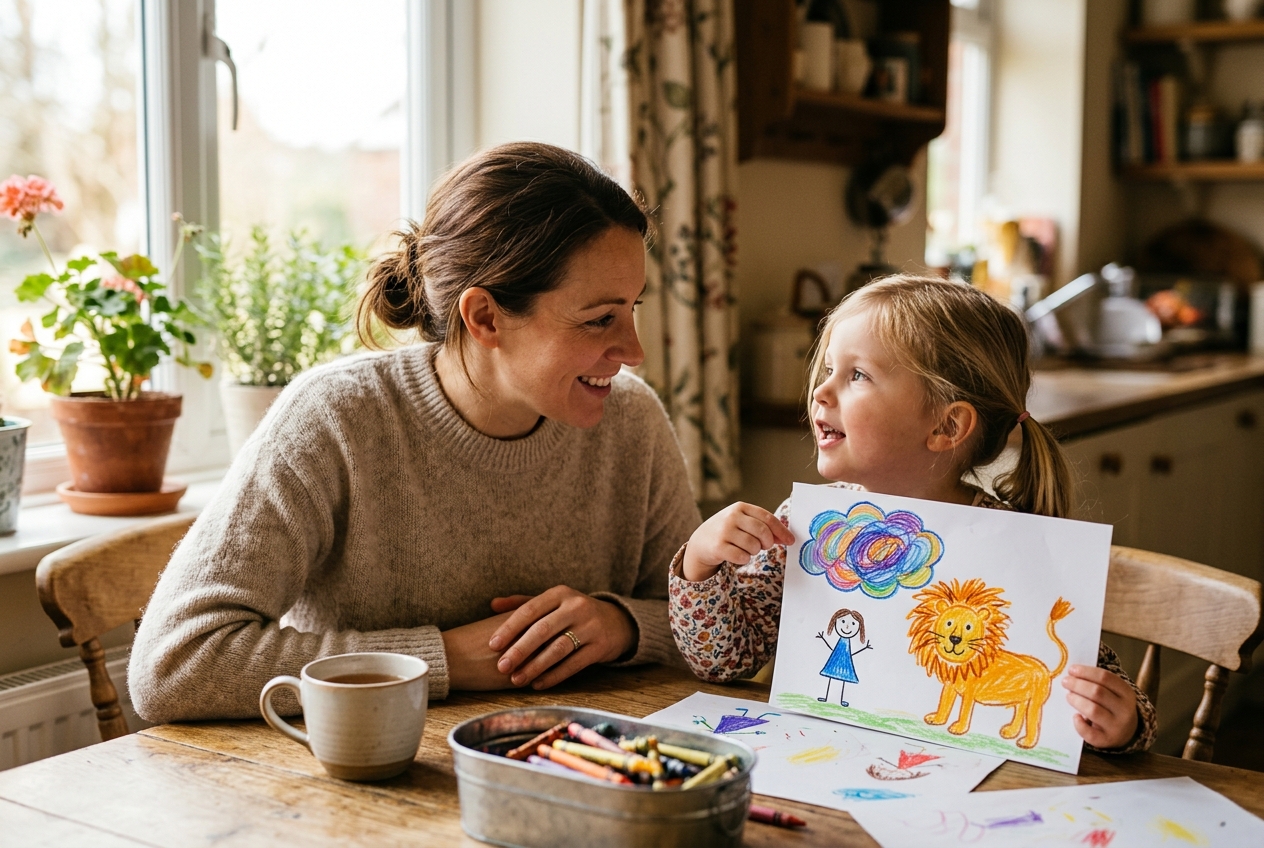
When a child describes their drawing, they almost always tell you more than the drawing does. The blob is not a blob; it is the noise their teacher made when she dropped the bowl. The two figures standing apart are not estranged; they are practising for sports day. The orange shape with teeth is the hand dryer at nursery. You would not have got there with questions. You got there because you let the child lead. For more on these small, careful conversations, you might enjoy our piece on how to talk to kids about their art — it goes deeper into the small phrases that build a child’s confidence.
Setting Up a Home That Invites Feeling-Drawing
You don’t need an art studio. You need three things, and they are quietly powerful.
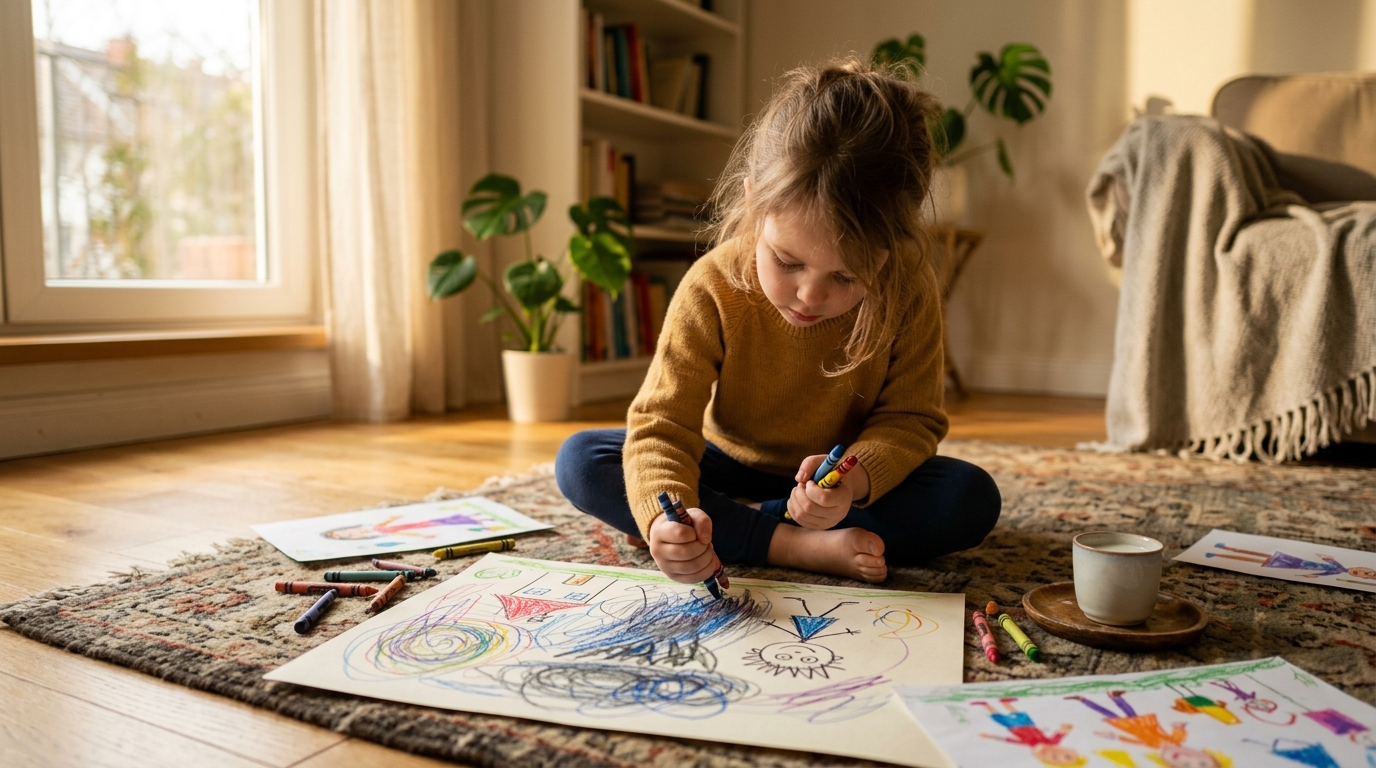
A low surface and a tub of supplies always within reach. Children draw what they feel most freely when reaching for crayons is as easy as reaching for a snack. A small basket on a kitchen shelf — not a special art cupboard you have to unlock — lowers the threshold so far that drawing happens before the feeling has a chance to harden into a tantrum.
Plain paper, lots of it. Colouring books and printed worksheets are fine for some moods, but they don’t give a child anywhere to put their own feelings. A stack of cheap A4 paper is the single most useful emotional-regulation tool in the house.
A grown-up who is nearby but not watching. This one is delicate. Children draw their truest feelings when they don’t feel observed, but they also need to know you are there if they want to talk. Sitting at the same table with your own cup of tea and your own book is perfect. Hovering and asking “what’s that?” every two minutes is not.
If you want a few low-pressure ways to invite drawing without making it a “feelings exercise,” our roundup of fun drawing activities for kids has plenty of gentle prompts that quietly do the same emotional work.
Where AI Tools Fit In (Carefully)
A question that comes up a lot from parents lately is whether digital art tools have any place in this picture. The short answer is yes — gently, and only on the child’s terms.
When a child has drawn something on paper that clearly matters to them — the monster, the missing grandparent, the dragon that protected them at the doctor’s — there is something quietly magical about seeing that same drawing transformed into a polished version they can keep, print, or share. Tools like DrawToLife let a child photograph their crayon drawing and watch it turned into a finished piece of art in a style they choose. For a child who has just spent twenty minutes drawing a worry, that small ceremony of yes, this matters enough to keep forever can be its own form of emotional closure.
The key, as with any screen time, is that the digital part comes after the feeling-drawing, not instead of it. The crayon work is where the regulation happens. The AI bit is the framing on the wall. Keep that order right and you have a beautifully calm little ritual; flip it, and you’ve just turned drawing into another performance.
The Hardest Drawings to Receive
A small note for the moments when a drawing is genuinely hard to look at — a picture of grief, of a frightening event, of something that names a worry you already had. The instinct is to react: to ask too many questions, to praise too much, to put it away.
Try instead to do what the child did. Sit with it. Say “thank you for showing me this.” Ask the question. Listen to whatever they say without trying to fix it. If something they describe needs adult help — a person who has hurt them, a worry that won’t lift, a sadness that isn’t passing — you’ll know, and you can act. Most of the time, though, the drawing itself was the action. They drew the hard thing because they needed to see it outside their own head. You being there to see it with them is the rest of the job.
A Final Thought
Children have been drawing their feelings for as long as there have been children and walls. Cave paintings, fridge drawings, doodles on the back of homework — it is one of the oldest and most universal ways humans of any age make sense of being alive. The fact that your three-year-old can do it without ever having been taught is one of those quietly miraculous things about being small.
So put the paper out. Keep the crayons low. Ask the open question. And when your child slides a drawing across the table that surprises you, hold it gently. They have just trusted you with something they couldn’t quite say. That is not a small thing — that is the whole point.